

Last year, I participated in an April (Poetry Month) 30/30 group — something I’ve done each year since the pandemic. The idea is to write a poem a day (or try to), using prompts that make starting a little easier. Often this is done in groups, as a local and/or international event, in-person, or online. Edmonton’s Stroll of Poets does it through the mildly moderated anarchy of an open Google Doc.
One of the 2024 prompts called for a traditional ekphrastic poem, which describes a painting. I stumbled across this one — “Whaling Grounds in the Arctic Ocean” — while browsing the incredible Rijksmuseum (rijksmuseum.nl) website. I had recently learned about early Dutch whaling on the Greenland coast, which started in the 17th century on an industrial scale. Storck’s painting drew me a little deeper into the history and the geography.
Whale Hunt in the Arctic Ocean
It’s an enclosing world: three ships, four boats,
their Basque and Frisian crews in the foreground,
flensing and harpooning bowheads while a baleen
and blank-eyed, badly-rendered walruses
watch one bear shot, another speared and bleeding out,
about to be cut down from behind with a head spade.

There’s still time for the processing to begin
before the pink sky darkens toward Greenland,
before Miseryfjellet disappears in Barentszoon’s sea —
blackness but for the light among the carcasses,
the tryworks’ fires boiling blubber through the night,
three ships hove to, three whales flayed on ice.

On every mast, oranje-blanje-blauwe
becomes the sky, the muzzle flash, the blood;
the snow, the sails, the gulls;
the sea, the whales, the shadowed land.
Now come three fates: what was, what is,
what may become one warming polar sea.
The Painting and the Poem
Abraham Storck, Walvisvangst in de Poolzee (Whaling in the Polar Sea). Rijksmuseum, Amsterdam, SK-A-4102. Public domain, via Wikimedia Commons.
Storck painted the Dutch Arctic fishery at its height, when Amsterdam and the Frisian ports sent fleets to the waters around Spitsbergen and Jan Mayen — islands in the Svalbard archipelago. They hired experienced Basque crews for the harpooning. The tricolour on every mast is the oranje-blanje-blauwe, the old Dutch Prince’s flag whose orange band later faded (often literally, from oxidation) to red.
The scene is not a historical document. Storck worked in Amsterdam and probably never sailed into the Arctic. The ice is neatly arranged, and the walruses are drawn by a man who had plainly not met one. What Storck does record accurately is the industry — the flensing, the boats, the bears killed for being in the way. See also Walvisvangst bij de kust van Spitsbergen, 1690.
The Three Fates
The Norns are the Norse equivalents of the Greek Fates and also the names of the three peaks on Bear Island (Bjørnøya) — part of the Norwegian Svalbard archipelago in the Barents Sea. Miseryfjellet (Misery Mountain) is the tallest peak. Three other peaks are named after the Norns. Given the presence of bears in Storck’s painting, it’s possible he was imagining Bear Island.
Urðr is “that which became,” Verðandi “that which is happening,” Skuld “that which shall be” — what was, what is, what may become. They sit under the world-tree, Yggdrasil (literally, “Odin’s horse”), at the well of Urðr and decide how long a life runs.
Skuld also carries the sense of a debt, something owed and due. That is the word the last line suggests: a warming polar sea is not a prophecy so much as an account coming payable.


The Greek Fates each have a task: to spin, measure, and cut the thread representing an individual life. Goya’s “Atropos” focuses on the cutter but shows all three — and the helpless person whose lifespan is being determined. In Norse literature, the Norns carve runes but are often represented in modern art as weavers, too.
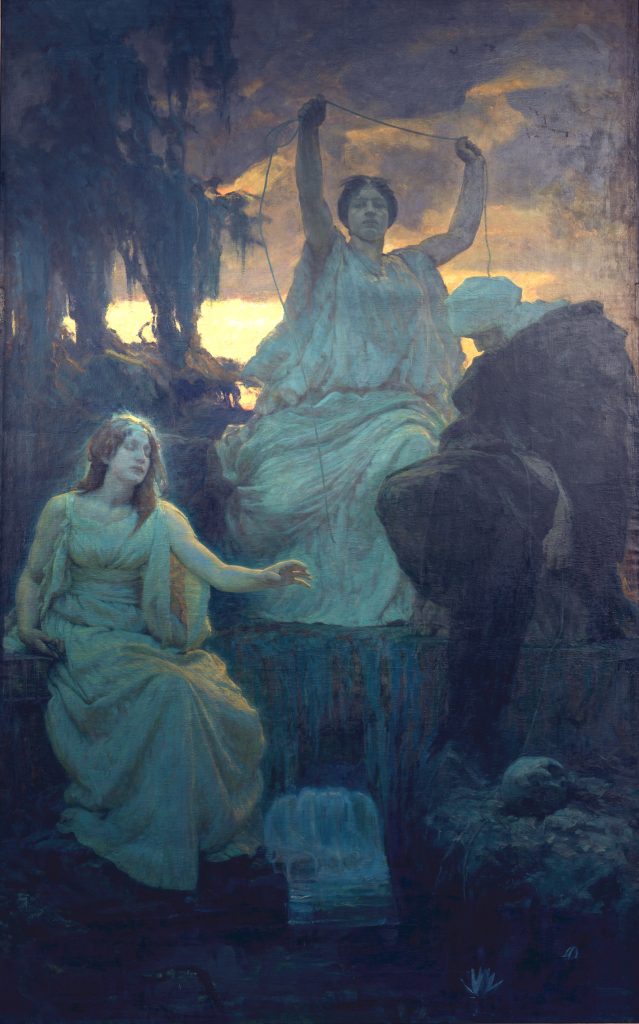
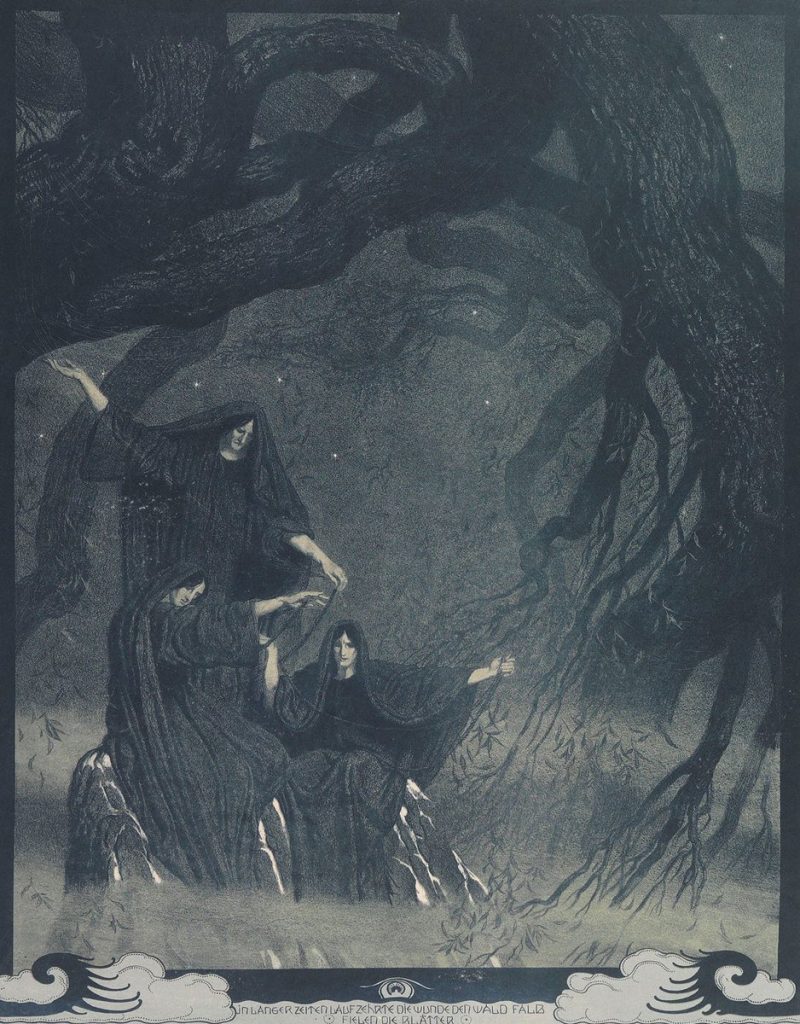
Delug puts his Norns at the well: one holds the thread taut overhead, one reaches toward it, and the third turns away into shadow — the one you cannot see is the one who determines your end. Stassen sets his Norns among the roots of Yggdrasil and includes a line from Wagner’s Götterdämmerung along the bottom border: In langer Zeiten Lauf zehrte die Wunde den Wald, falb fielen die Blätter. / In the long course of time the wound consumed the forest, and its leaves fell. A world-tree dying of an old injury is another way of depicting a cosmic debt.
Thank you for reading!
Cite this note: Dan Knauss, “Walvisvangst in de Poolzee,” Marginalia, 7 April 2025, https://m.arginalia.com/whale-hunt-in-the-arctic/.
Last updated:


_-_Original_colors_image.jpg)


Leave a Reply