
The French literary theorist Gérard Genette’s 1987 book, Paratexts, is about the parts of a text that are not considered the text. It begins with a borrowed word for its French title — Seuils — meaning “doorsteps” or “thresholds.” This is because the paratext, Genette writes, is “more than a boundary or a sealed border.” It is “a threshold, or — a word the Argentine writer and librarian Jorge Luis Borges used apropos of a preface — a ‘vestibule’ that offers the world at large the possibility of either stepping inside or turning back.”1
As a caveat, let me be clear this is a genealogy of the Western, Latin book and its journey into the vernacular. The commentary traditions of China, the Islamic world, and the Talmud built their own apparatuses, and they deserve their own telling. In “Get things done by not doing them,” I took a deep dive into Laozi, wu wei, and the Buddhist idea of emptiness as open, generative space for creative work in programming and poetry. The margin of a text is that kind of open, generative space, and my future essays may come back to eastern (and western) perspectives on negation, with an eye to what it might offer to the web and media technology.
When I named my WordPress bibliography plugin after Borges, I was thinking of his library, not his books or their vestibules. In his famous short story, “The Library of Babel,” a magical library contains every possible book, which means it also contains every false catalogue of itself and every refutation of the true one.2 It’s a library that’s all content with no reliable apparatus to navigate it, so nobody can find anything or trust what they find. That is a fair description of a web page with no citations or history — and a good deal of the web today.
While early hypertext theory prioritized provenance, the standards that ultimately defined digital documents traded trackable sources and influences for scale and simplicity. This has left us with a flat digital surface and a single, semantic layer to be decorated, made interactive, and augmented perhaps by additional machine-readable formats. A link connects two documents but records almost nothing about the relationship: whether one cites, quotes, corrects, or contradicts the other, or what the linked page said when the link was made. Even authorship is underspecified.
None of this is a technical impossibility. The web permits citation, provenance, and annotation; the W3C has even standardized a model for attaching a comment to a particular passage, with its author and context.3 But browsers do not supply that apparatus by default, and commercial publishing rarely rewards anyone for adding it. The web made publishing and linking an ordinary, mundane activity while marginalizing the important work of making texts accountable. That work was delegated to optional tools, specialist practices, and institutions. It was an afterthought, if it was thought about at all. The political question is how the work of checking a text is distributed: what the publisher must supply, what the reader must reconstruct, and what neither can recover.
This series is about the apparatus or interfaces in printed and written texts that have done the work the web we have today made optional.4 The interfaces that evolved with books are also thresholds and vestibules of invitation and conversation: the tables of contents, indexes, glosses, notes, running heads, bibliographies, colophons, and records of correction that the written and printed page accumulated over two millennia. Each of them is a navigational interface, a tool for finding your way, checking a claim, or answering the author(s). Each is also a tool of power, because whoever builds the apparatus decides how a text can be read, who can read it, and how responsive it will be to revision, to comments, and to questions.
- This first essay (below) explains how the codex grew its now-familiar interfaces.
- The second essay will explain how the early web omitted them.
- The third essay will consider where the bookish apparatus may be making a comeback on the open web — and who will get to define it.
The page is a piece of paper. It is also a visible and tangible proportion, silently sounding the thoroughbass of the book.
Robert Bringhurst
Finding things
The table of contents is older than the codex. Pliny the Elder, the Roman naturalist who would die commanding the fleet at Misenum when Vesuvius erupted in 79 CE, wrote his Natural History on a scroll. In Pliny’s dedication to the future emperor Titus, he explained that, to spare a busy man, he had “subjoined to this epistle the contents of each of the following books (liber), and have used my best endeavours to prevent your being obliged to read them all through.” Pliny’s device would serve other readers too, “so that any one may search for what he wishes, and may know where to find it.”5 That is the whole case for an index, made in the first century: reading is costly in time, so a good apparatus lets you read less to more quickly acquire the same knowledge you would get by plodding through the text without it.
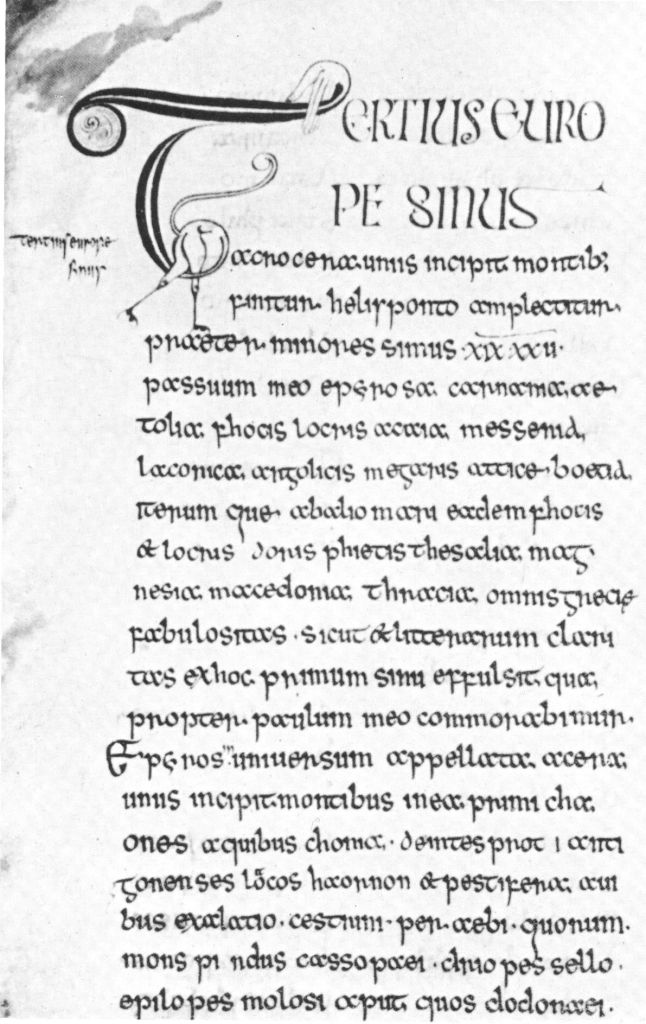
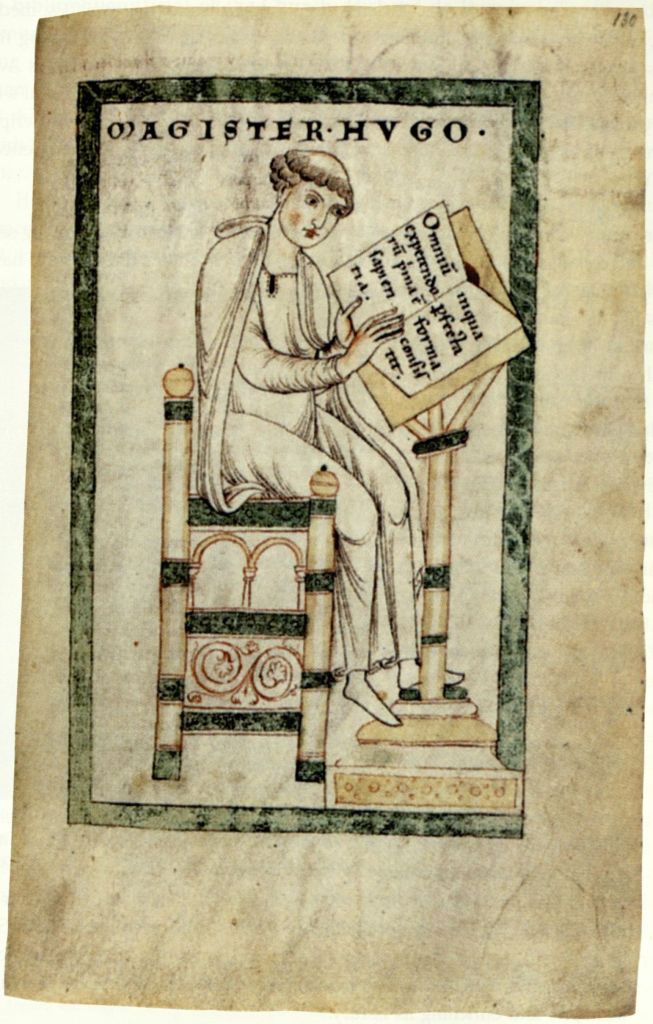
Fittingly, it was Pliny who also recorded how pagina (from pangere, to fasten or stake) referred to the staked quadrants of a vineyard, which is why it was later applied to a folio sheet with lines of text instead of strings and trellises to carry grapevines. Ten centuries later, this analogy delighted Hugh of St. Victor. Hugh was a canon regular: one of the priests who lived together under the Rule of St. Augustine, praying the hours like monks, but in the world rather than withdrawn from it. His house, the Abbey of Saint-Victor in Paris, kept a school that was among the most famous of the twelfth century, and he was its leading master.6 Hugh extended the vineyard to the medieval scriptorium, where the task of the reader was not to go quickly or alone. Instead, they harvested the grapes of wisdom from the vineyard of the text into the storehouse of memory, murmuring the words aloud, like wind through the leaves. Up to the tenth century, monastic reading was rarely silent or private; it was usually vocalized and social. A group of monks reading, chanting, or praying were engaged in the same activity. Each activity looked, felt, and sounded like the others. Each activity was directed toward the same spiritual, intellectual, and communal goal.7
The medieval book took a long time to adopt the table of contents. A millennium passed before Pliny’s apparatus began to be copied at scale. Finding the correct book or section of a text to quickly read only what was needed at the moment cut against the older practices and principles of medieval learning where wisdom and spiritual development could not be acquired quickly through shortcuts.
Pliny’s goal of enabling a superior to move quickly through a text with a kind of executive summary had practical value in the Empire’s administrative and bureaucratic context. It also had a fundamental conflict with Hugh and his fellow canons’ slow, ponderous rumination through each page, without urgency or any desire to read everything, just the right things to become wise and serve others. The Oxford palaeographer M. B. Parkes distinguished these two kinds of reading: “The monastic lectio was a spiritual exercise which involved steady reading to oneself, interspersed by prayer, and pausing for rumination on the text as a basis for meditatio. The scholastic lectio was a process of study which involved a more ratiocinative scrutiny of the text and consultation for reference purposes.”8 Hugh, a canon who prayed like a monk and taught in a school, stood on the threshold between them.
These two kinds of reading required different books and different readers with different vocations. In the twelfth and thirteenth centuries, the schoolmen and the preaching orders filled the second category and created the scholastic reference. Parkes called the principle it was based on ordinatio — ordering information by dividing a text into books, chapters, and other distinctions, marking them with running titles and coloured initials, and adding tables and alphabetical indexes so that a reader could consult a text rather than read it all the way through.9
The historians Richard and Mary Rouse took the title of their study of these “new attitudes to the page” from the scholars’ own phrase, statim invenire, to find at once.10 Ivan Illich, the Vienna-born critic and historian of technology, put the same change in starker terms. Around 1150, he wrote, “three hundred years before movable type came into use,” a “combination of more than a dozen technical inventions and arrangements” transformed the page “from a score for pious mumblers into an optically organized text for logical thinkers.” It “made it possible to imagine the ‘text’ as something detached from the physical reality of a page.”11
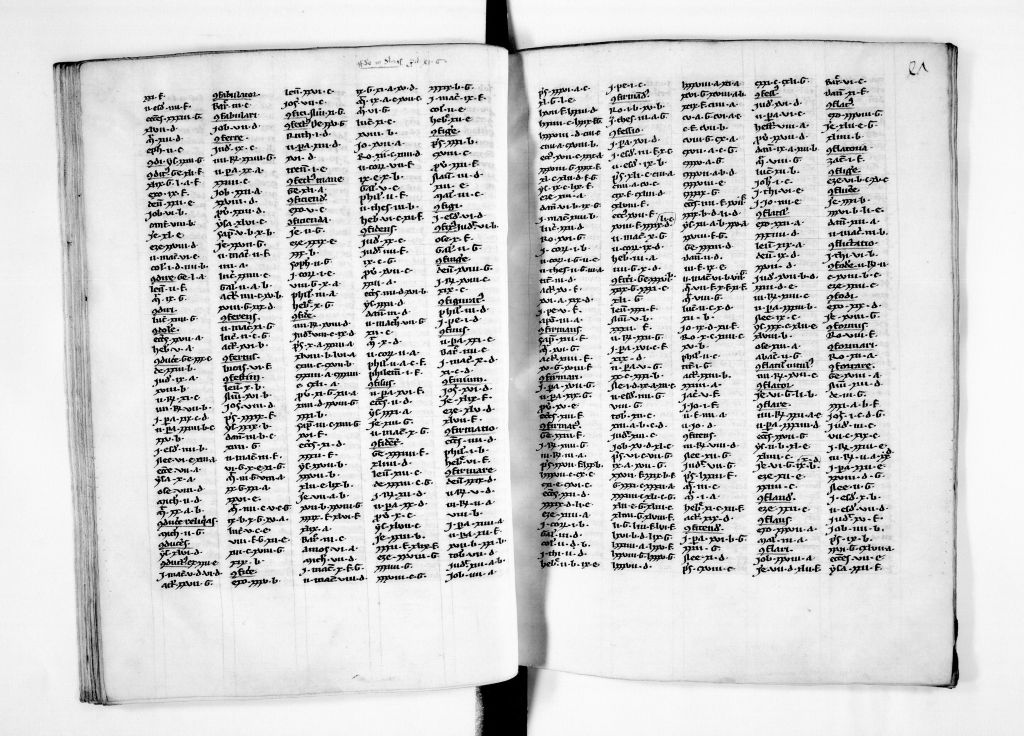
Once these old tools arrived in a new cultural moment that recognized their use, they spread quickly. Robert Grosseteste, an Oxford scholar who became bishop of Lincoln, built a subject index, his Tabula distinctionum, to the books he read. The Dominicans of Saint-Jacques in Paris compiled a word-by-word concordance to the Latin Bible.12 These were the search engines of the thirteenth century, and like ours they were built by the institutions that needed them most: universities training theologians, lawyers, and preachers whose mastery of grammar, logic, and rhetoric still had to find the right authority to cite for the right argument, quickly.
Writing around the text
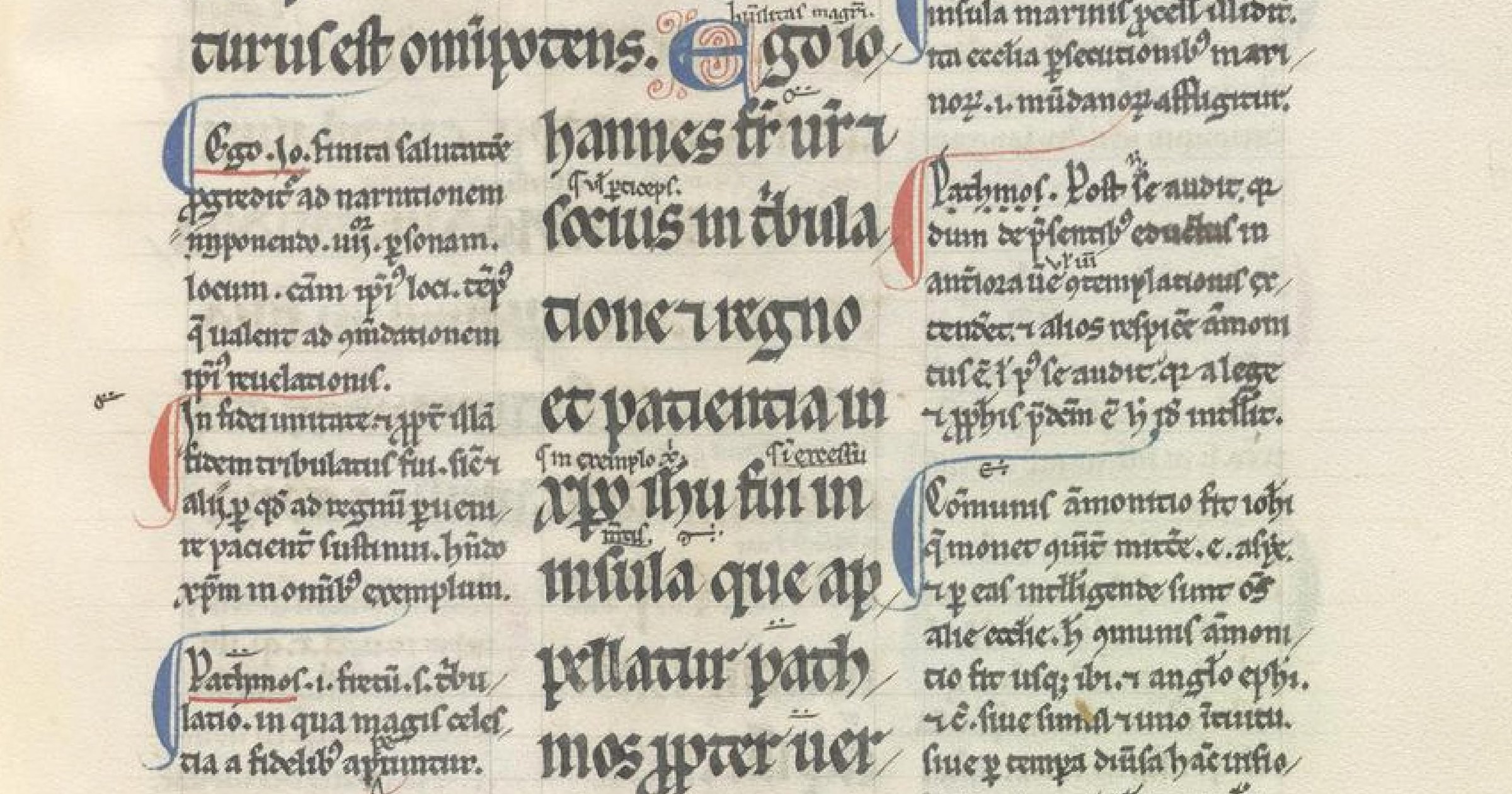
The gloss is the apparatus at its most visible. In the great glossed Bibles of the twelfth century, “the text of the Bible itself appears in large characters in a central column on each page; brief interpretive comments, or ‘glosses’ are written between the lines, while longer remarks appear in the margins.”13 The page is a diagram of authority. Scripture sits in the middle. The accepted commentary, the Glossa Ordinaria, surrounds it, literally the “ordinary” or standard gloss. A reader learns what the text says and how it is to be read in the same glance.

Who is allowed to write in the margin of scripture, and whose gloss becomes ordinary, were questions of doctrine and of power, settled by the institutions that controlled the scriptoria.
The Canadian media theorist Marshall McLuhan saw the medieval classroom as an extension of this page: “The classroom tended to be a scriptorium with a commentary. The student was an editor-publisher.”14 He called manuscript culture “conversational,” because writer and audience were related “by the form of publication as performance.”15 The glossed page holds a conversation across centuries. It also limits who may join it. Who is allowed to write in the margin of scripture, and whose gloss becomes ordinary, were questions of doctrine and of power, settled by the institutions that controlled the scriptoria.
Readers kept writing in margins long after the gloss was standardized, which is where this blog, Marginalia, gets its name. The literary historian H. J. Jackson’s history of readers’ marginalia traces the sharpest modern anxieties about the practice of writing in books to Britain’s Public Libraries Act of 1850, when a shared book began to look like public property that any reader could freely deface.16 It seems that online comments and social media have been going through a similar rise and fall, with regulators straining to check abuse of public media in the first decades of the twenty-first century.
Print and its finding aids

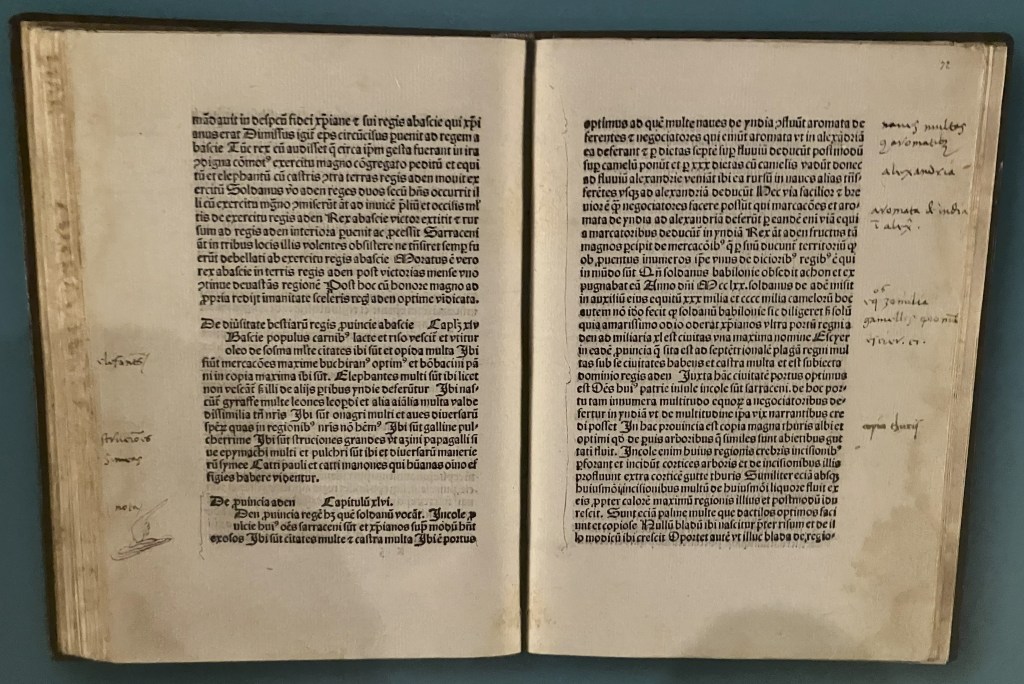
Printing did not invent the book’s apparatus — it standardized what scholars since Pliny had already done. The historian Elizabeth Eisenstein argued that “increasing familiarity with regularly numbered pages, punctuation marks, section breaks, running heads, indices, and so forth, helped to reorder the thought of all readers, whatever their profession or craft.” Even “the most inconspicuous innovation could have weighty consequences.” Arabic pagination meant “more accurate indexing, annotation, and cross-referencing.”17 One of the first printed books with numbered leaves was a short sermon by Werner Rolevinck, printed in Cologne in 1470 by Arnold Ther Hoernen.18 Once every copy had the same leaf numbers, an index compiled from one copy worked for all of them, and a reference in one book could point precisely into another. “Typographical fixity,” Eisenstein wrote, “is a basic prerequisite for the rapid advancement of learning.”19
Two very different people can seem to manage without an apparatus: someone powerful enough to escape demands for evidence, and someone shut out from the means of supplying it.
The historian of science Adrian Johns has argued more recently that this fixity was not automatic, but something printers, booksellers, readers and institutions had to produce. “Printed texts were not intrinsically trustworthy,” he writes. “When they were in fact trusted, it was only as a result of hard work. Fixity was in the eye of the beholder, and its recognition could not be maintained without continuing effort.”20 Pirated editions, careless compositors, and rival printers meant that readers had to learn whom to trust. The apparatus was part of how they learned: title pages, imprints (impressum), privileges (privilegium), errata lists, and the names of editors and correctors were claims about where a text came from and who stood behind it. The Princeton historian Anthony Grafton has shown how much of that work fell to correctors, a “new social type” and a skilled vocation that print created.21 The same presses printed careful editions and careless pamphlets. Trust came from the labour and the institutions behind a book, not from the medium, and that is the fair measure for the web as well: who pays for the apparatus, who maintains it, and who can do without it? Two very different people can seem to manage without it: someone powerful enough to escape demands for evidence, and someone shut out from the means of supplying it.
The book in the hand
A is for Aldus
Because he knew the manners of men
and how to praise their folly, he could
¶ Begin again, speed slowly to go far,
get Griffo to cut queer ligatures
or we’d still be reading blackletter.
Italic, octavos, Penguin 60s for 60p –
Thank Aldus, Bembo, and Griffo for them,
Quia noueram mores hominum.
“The page is a piece of paper,” the Canadian typographer and poet Robert Bringhurst writes. “It is also a visible and tangible proportion, silently sounding the thoroughbass of the book.”22 The apparatus is not only printed on the page. It is folded into the book. A folio is a printed sheet folded once, a quarto twice, an octavo three times, and each fold tells a reader something before a word is read: what kind of book this is, where it is meant to be read, and by whom. The great glossed Bibles and the printed Gratian were lectern books, often chained and locked down. They were consulted in a fixed place, by readers entitled to be there, with the commentary laid around the text like a fence.
In Venice in April 1501, Aldus Manutius published a book of Virgil’s major poems in octavo, set entirely in a new italic type cut by his punchcutter, Francesco Griffo. Griffo had already cut the roman type for Pietro Bembo’s De Aetna of 1496, the first Latin literary text Aldus printed, which the Monotype foundry revived in the late 1920s as a serif font named Bembo. The italic was modelled on the humanists’ chancery cursive, and with some sixty-five joined letters (ligatures) it fitted more text onto a small page.23 It was the first of a series that Aldus called his libelli portatiles, his portable little books.24 He told Scipione Fortiguerri that he was printing Juvenal and Persius “in a very small format,” “so that they may more conveniently be held in the hand and learned by heart.”
Dedicating an edition of Catullus to the Venetian diarist Marino Sanudo in 1502, Aldus promised that the format would let readers “come and go with Catullus constantly and conveniently in hand.”25 Small books were not new, but well-edited classical literary works were new to the format, especially elite erotica like Catullus’ poetry. Books of hours and breviaries had long been made to be carried. What Aldus did was give the format to the classics of secular literature, including the top-shelf smut of his day, and he printed them, as John Grant puts it, “unencumbered by any surrounding commentary.”26 They were not cheap. A Greek octavo cost roughly a schoolteacher’s weekly wage.27
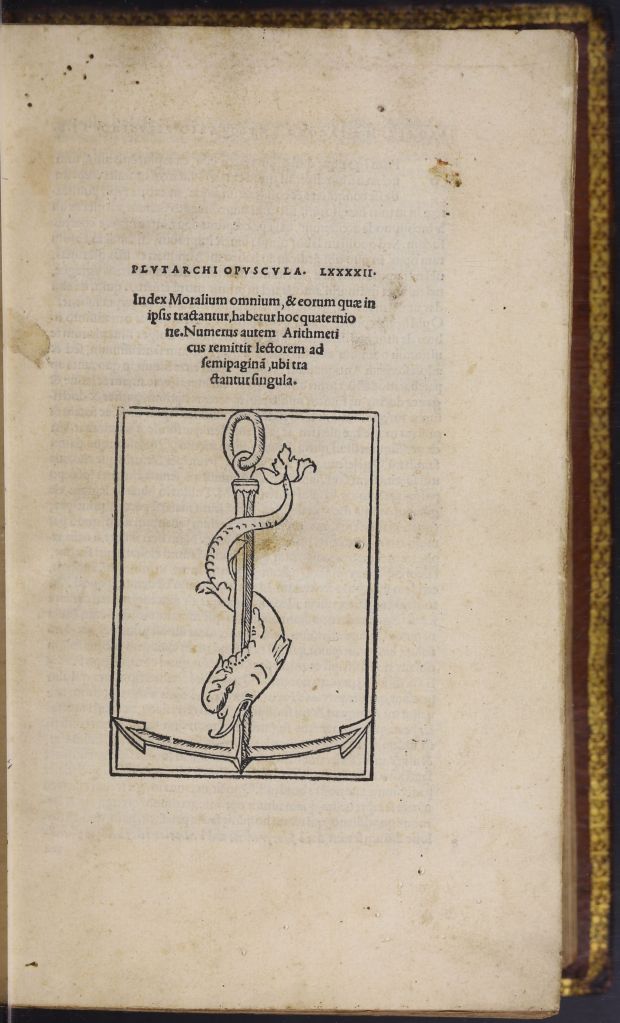
Aldus’s printer’s mark, first used in 1502, was a dolphin wound around an anchor, taken from a silver denarius of the emperor Titus that Pietro Bembo had shown him. Erasmus, whose Adages Aldus printed in 1508, read it as the proverb Festina lente, “make haste slowly.” The dolphin represented speed, the anchor stability.28 The pocket book was all dolphin. Within two years printers in Lyon were selling counterfeit Aldine octavos, and in 1503 Aldus issued a broadside complaining that “in the city of Lyon our books appeared under my name, but full of errors,” with a list of those errors so that buyers could tell the fakes. The Lyon printers corrected them and kept pirating.29 An errata list had become a certificate of authenticity! This is Adrian Johns’s argument in miniature: the anchor had to be set by hand.

Italic itself did not stay in the text. Aldus “used the Italic type as a text letter, and such use continued frequently for a century,” a printers’ primer of 1918 recalls. But by then italic had moved into the apparatus: book titles in footnotes, “see” and “see also” in indexes, a word set apart for emphasis.30 The pocket book, meanwhile, kept getting cheaper. Allen Lane’s Penguins sold for sixpence in 1935, the price of a packet of cigarettes, and the German typographer Jan Tschichold, who in 1928 had called for a neue Typographie, spent the late 1940s writing Penguin’s composition rules for its italics, references, and footnotes.31
The pocket classic moved power in two directions. It took the text off the lectern and out of the institution that controlled the gloss. It put literature into private hands, for a reading that answered to no glossator, or the glossator one happened to prefer.32 It also stripped the text bare. The humanist call, Ad fontes! — Back to the sources! — produced a clean, idealized, increasingly abstract and disembodied text for a solitary reader: one author, one reader, and nobody in between.
Humanist reading fed into Protestant reading, whose most radical tendencies of iconoclasm and republicanism seemed to invite anarchy. Claiming a direct relation to the highest authority and author — with no priest, bishop, or church between them — the individual reader could become an ungovernable subject in an angry theocratic mob, a revolutionary with levelling, communitarian tendencies, or a self-governing citizen with their own business interests. Historians have followed each of those readers into the English, American, and French revolutions.33 But the bare text never stayed bare for long. A change of format redistributes mediation; it does not abolish it, as Luther and his students were about to show.
The political page
Before Europe fragmented into violently opposed religious confessions, Erasmus used the emerging republic of print to make his most consequential achievement as a humanist scholar and philologist or textual critic: he made one book’s apparatus an argument. His Novum Instrumentum, printed by Johann Froben in Basel in 1516, set the Greek New Testament in one column and his own corrected Latin in the other, followed by long Annotationes defending each change.34 The layout was itself the argument, and a politically charged one. Erasmus chose his title deliberately: a testamentum need not be written, but an instrumentum is a written document, and that is what his edition offered to correct.35
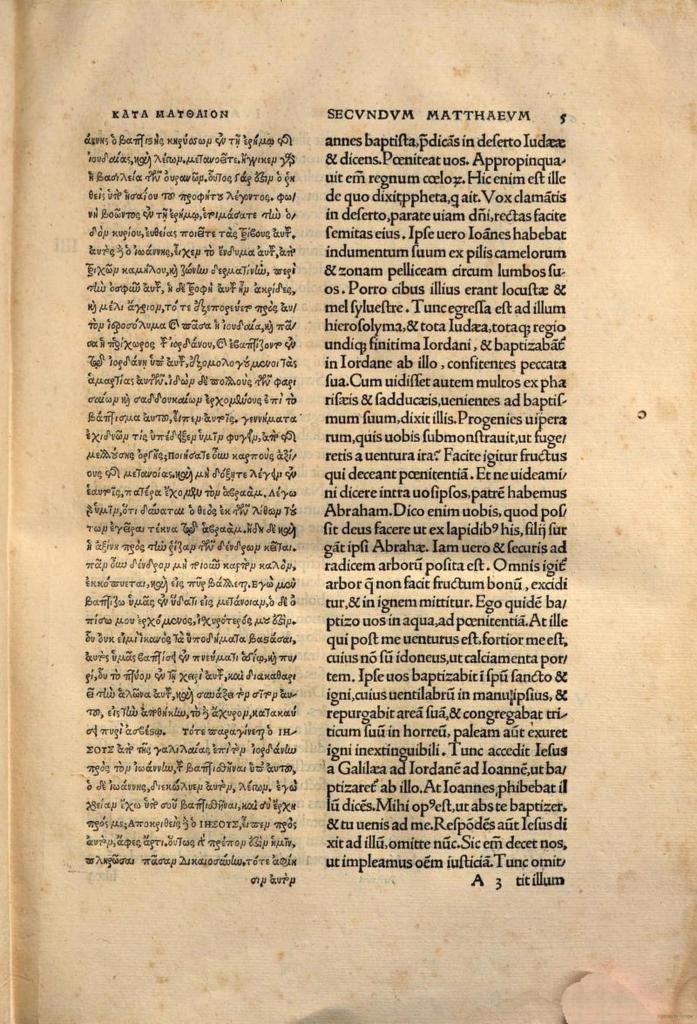
Once the Greek stood beside a Latin that departed from the Vulgate handed down from St. Jerome, the church’s Bible became a translation that a reader could check and find quite fallible. Erasmus was a master of a revived, elegant Classical Latin, whereas Jerome was a master of Late Antique Latin who used a rugged, ultra-literal style that was eleven centuries out of fashion, and never very conversant with its Hebrew and Greek sources. Erasmus’s annotations were partly a defence against the problems print culture was surfacing — the mass proliferation of error, opinion, and alternative facts. They also had the effect of emphasizing these problems existed, even in holy writ.
How could anyone find the truth? Erasmus’s notes on the biblical text were meant to protect emended readings that would otherwise be “liable to be corrupted again” by later copyists and compositors.36 In some cases, Erasmus argued with his own text and the powers that pressured him to include spurious passages.37 This is Johns’s point seen from the editor’s desk: textual stability and fixity — increasingly the ground of its authority — had to be guarded, and the apparatus was the guard, albeit a shaky one.
Erasmus’s annotations were partly a defence against the problems print culture was surfacing — the mass proliferation of error, opinion, and alternative facts.
At the same moment, Luther shows the reverse movement: print supplying the space for an apparatus that readers wrote themselves. For his first lectures on the Psalms in 1513, he “contracted with Johann Grunenberg to print, in a special edition with wide margins and generous interlinear spaces,” the Latin Psalter.38 Luther wrote his glosses into his own copy, and “the students were expected to enter into their own, identical copies” what he dictated.39 Luther’s annotated copy survives in Wolfenbüttel. For his lectures on the book of Romans in 1515–16, he asked that “each line of Paul’s letter would be printed far apart from the other lines” “so that notations [Glossen] could be made.”40 This turns the Glossa Ordinaria inside out. The printer supplies a bare text and the white space around it. The lecturer supplies the gloss. Every student copies that gloss by hand into an identical page. McLuhan’s “scriptorium with a commentary” now had a press down the street. Students formatively educated in this way with personal, printed Bibles they wrote in themselves could come to treat scripture as both “a fairly stabilized text” and one that accommodated their own, or their teachers’, magisterial voices, in the biblical and local vernacular languages. Luther’s later fury at printers, whom he blamed for corruptions of his own writings and biblical translations, shows how much he had come to depend on that stability.41

The New Testament Luther published in September 1522 was a folio, translated from Erasmus’s Greek and equipped with Luther’s own prefaces and marginal glosses. It sold for a guilder, “two months’ salary for a schoolmaster.”42 By 1524 the Wittenberg printer Hans Lufft had issued a small-format Low German edition, with what may be the first woodcuts designed for an octavo Luther New Testament.43 The pocket New Testament carried Luther’s apparatus (his prefaces, his glosses, his judgements on which books mattered most) into lay hands, where no lectern stood between reader and text. Luther’s interpretation travelled with the format like a chaperone. A format is an interface too, and whoever sets it decides who can hold a book, where it can be read, and whose voice comes with it — up to a point.
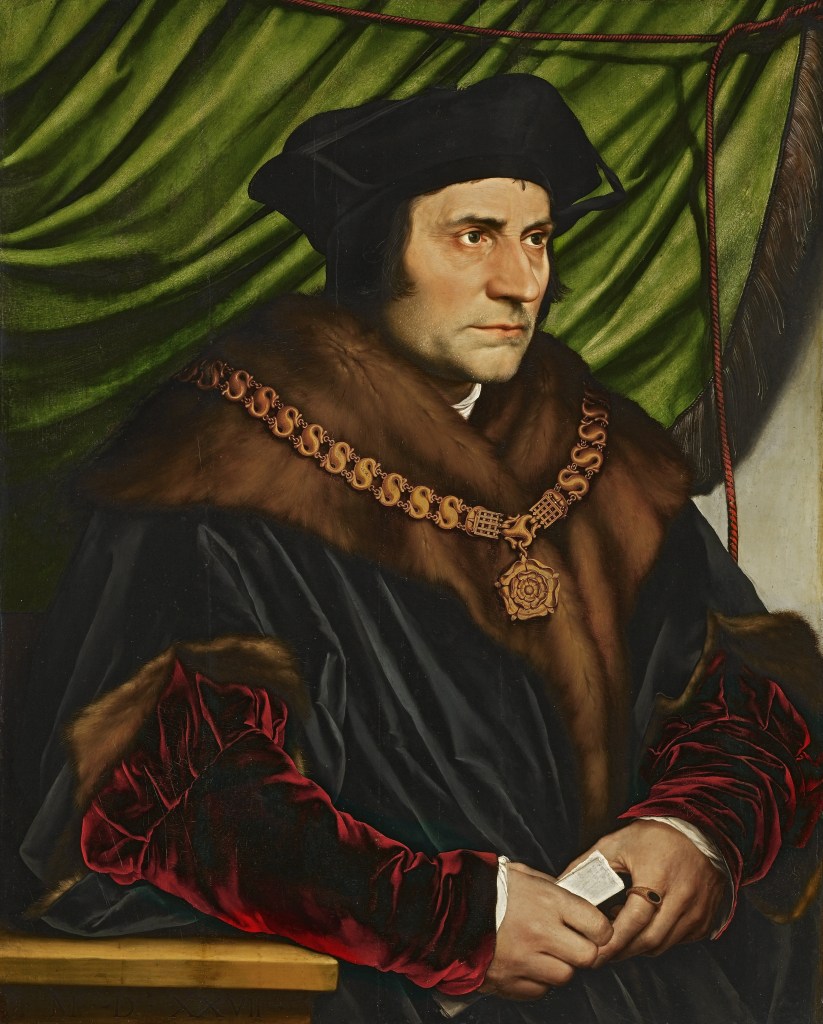
Erasmus had supplied Luther’s Greek, but he did not follow Luther out of the church. Neither he nor his friend Thomas More, whose name Erasmus punned on in the title of his Moriae Encomium, the Praise of Folly, foresaw that the humanist movement print had spread would end in religious division, war, and, for More, the executioner’s block in 1535.44
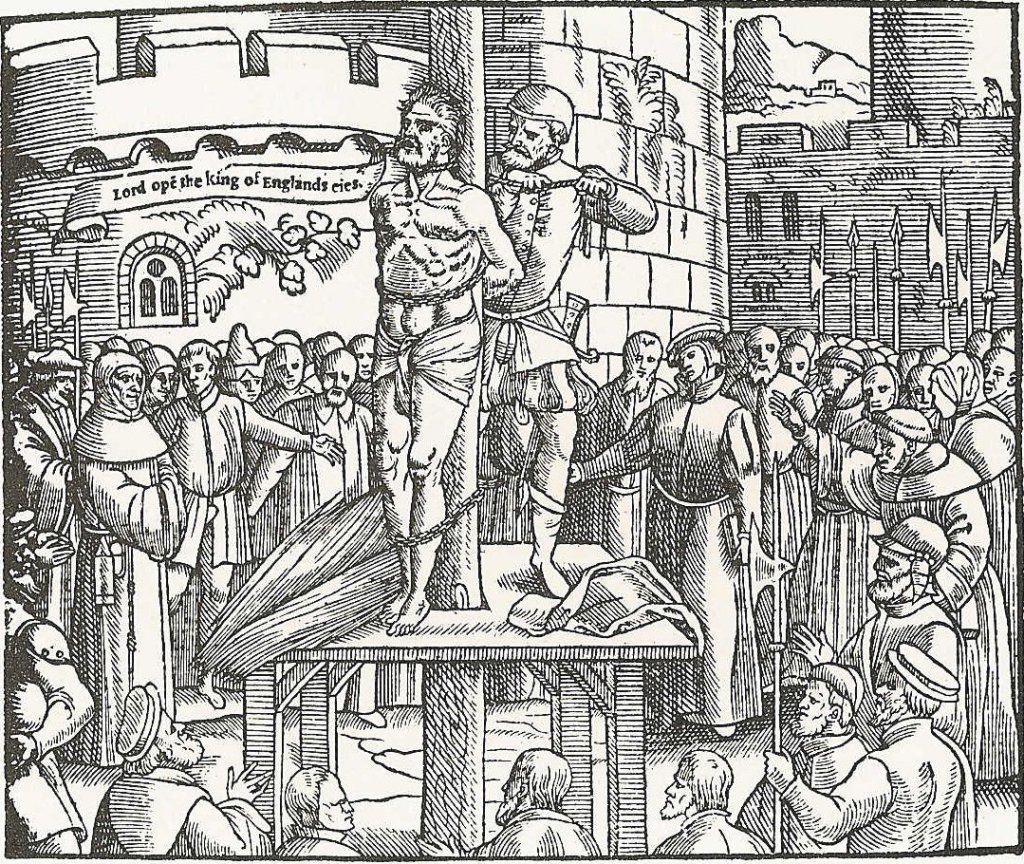
The press that made scripture checkable also cost its established interpreters their exclusive hold on the means of interpretation. Independence, new conformities, and coercion all followed, often in the same towns. The literary historian James Simpson argues that the evangelical reading of More’s opponent William Tyndale “did not produce either readerly liberty or freedom from institutional constraint.”45 More held that a common text has to be read within a common community. As Lord Chancellor, he pursued Tyndale’s followers in that community’s name, to preserve its unity and wholeness through violence.46 Tyndale and More fought in print, at enormous length. Tyndale was arrested in Antwerp in 1535 at the order of the “neither holy nor Roman”47 emperor’s procurator-general, condemned as a heretic, and strangled and burned near Brussels the following year, fifteen months after More’s own execution.48
Augustine had given Christian readers a gentler rule more than a thousand years earlier. Anyone whose reading of the scriptures does not “build up this twofold love of God and our neighbor,” he wrote, “does not yet understand them as he ought.” A reading that builds up love, even a mistaken one, is not a “pernicious” error.49 The rule of charity assumes readers who share a common world, but More shows that a shared world is not enough: preserving one can become the reason to persecute its dissenters. Christendom, the Christianitas Erasmus and More had written for in a common Latin language restored to its classical sources, no longer had the ecumenical universality that affords such irenic and convivial discourse. The harder question, then and now, is whether readers can keep their obligations to one another while disagreeing about the authority that should settle their disagreement.
Rome put Erasmus on its Index of Prohibited Books in 1559. In 1575, a purged edition of his Adagia, the book in which he had explained the dolphin and the anchor, appeared under the name of Aldus’s son Paolo, who had prepared it, and was published by Aldus’s grandson. Erasmus’s name was nowhere on the title page.50 The apparatus that names and credits can also unname.
Answerable texts
The footnote is the apparatus that makes a text answerable. “A hundred years ago,” Grafton writes, “most historians would have made a simple distinction: the text persuades, the notes prove.”51 Footnotes are “the humanist’s rough equivalent of the scientist’s report on data.” Without them, “historical theses can be admired or resented, but they cannot be verified or disproved.”52
Grafton’s account of how this works is a description of the page as an interface. “Once the historian writes with footnotes, historical narrative tells a distinctively modern, double story.” The notes “form a secondary story, which moves with but differs sharply from the primary one.” And: “Like an engineer’s diagram of a splendid building, the footnote reveals the occasionally crude braces, the unavoidable weak points, and the hidden stresses that an elevation of the facade would conceal.”53 The footnote lets a reader see how an argument was built, and dismantle it if it was built badly.
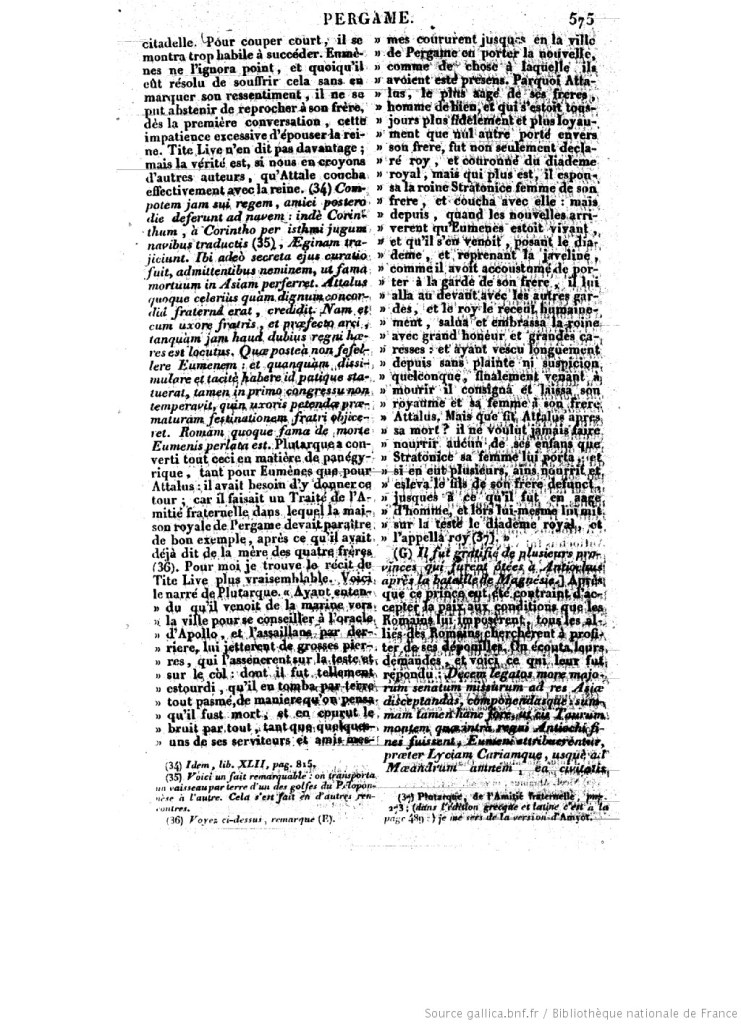
That is also why the footnote has always been a weapon. Grafton’s history is full of scholars using notes to flatten their opponents. And it ends with a sober claim for the form: “the culturally contingent and eminently fallible footnote offers the only guarantee we have that statements about the past derive from identifiable sources. And that is the only ground we have to trust them.”54 A note makes scrutiny possible; it does not show that anyone has scrutinized. A citation can misrepresent its source, hide a debt to an intermediary, or perform authority by sheer abundance. A responsible note also says what its author does not know, or knows only at second hand, as the note on Illich’s table near the end of this essay has to.
Answerability has at least three parts, and the book’s apparatus developed each separately. Notes and references make the basis of a claim inspectable. Commentary preserves objections and competing readings, as Erasmus’s Annotationes kept disagreements his text could not settle. Errata lists and corrected editions record revisions, so that later readers know what changed and why. Detecting an error is not the same as making the detection matter, and an apparatus that exposes a weakness without carrying the objection to the next reader has done only part of the work.
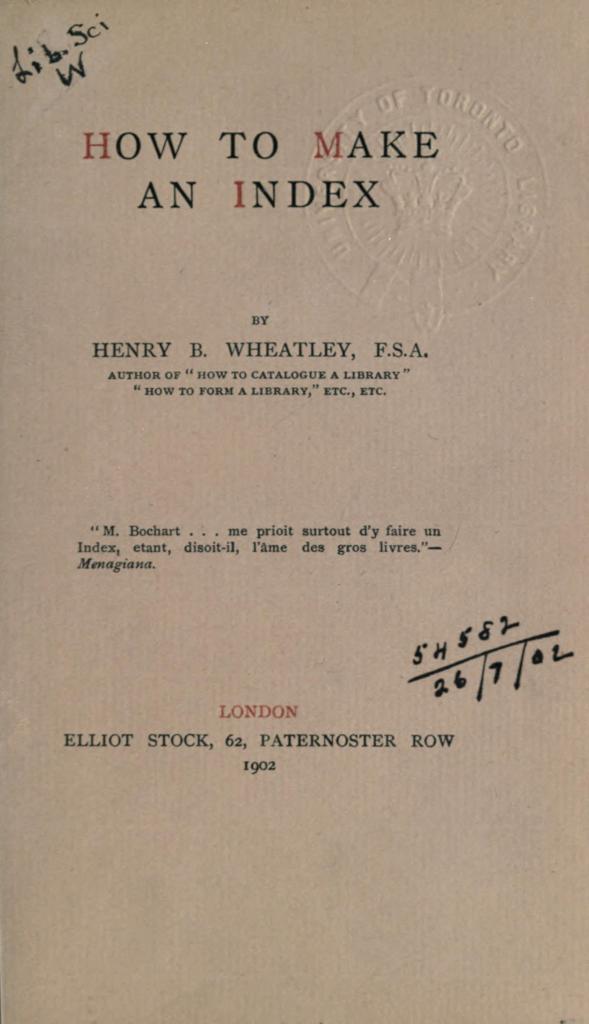
The index answers to someone too. Indexes look neutral and are not. The literary historian Dennis Duncan’s history of the index retells a story about Thomas Babington Macaulay and his History of England. Henry Wheatley, the Victorian authority on indexing, said Macaulay wrote a letter to his publishers, demanding, “Let no d—— Tory make the index to my History.”55 As Duncan says, the point is “that an unscrupulous indexer can radically change the emphasis of a text.”56 An index decides which names and topics a reader can find, under which headings, and in what terms. It can make a book argue with itself.
Bibliographic codes
All of this adds up to a claim about what a text is. The American textual scholar Jerome McGann argues that a text is not only its words but “a laced network of linguistic and bibliographical codes.” Its typeface, layout, binding, price, notes, and other paratexts carry meaning alongside its sentences.57 The apparatus is part of the text’s meaning, not packaging around it.
McGann also saw what the codex could not do. Critical editions, the most elaborate apparatus ever devised, are “ingenious machines,” he wrote, but “the critical edition’s apparatus, for example, exists only because no single book or manageable set of books can incorporate for analysis all of the relevant documents.”58 The book’s apparatus was a brilliant workaround for the technocultural limits of the book’s power, especially when it came to providing the official “critical editions” of texts with no originals, like classical epics, religious scriptures, medieval greats, and even modern literary works.59

The limits of media
In the 1990s it looked as though hypertext might remove those limits altogether. Illich, writing in 1993, thought the age of the book was ending, but not because networked computers were a better information tool than his Zettelkasten.60 “The book has now ceased to be the root-metaphor of the age; the screen has taken its place,”61 he wrote. Illich did not celebrate the change. One of his last books, In the Vineyard of the Text, looks back to the twelfth-century page to recover Hugh’s convivial kind of reading, the kind the screen was about to end.
By Illich’s measure, the codex is a convivial tool: it can be carried, opened anywhere, lent and resold without anyone’s permission.62 Illich was hard on most institutions, but not on the one that lends books. At its best, he wrote, “the library is the prototype of a convivial tool.”63 The codex’s conviviality depended on its size, its price, and who was allowed to write in it. It also depended on readers who could still meet in its margins.
Illich knew what it was to be sent away from a community. Summoned to Rome in 1968 by the successor to the Inquisition, he was dismissed with the words of Dostoevsky’s Grand Inquisitor: “Go, go, and return no more.”64 He also refused the vocabulary that would replace people meeting in the margins of books or through correspondence with an “electronic village.” “I have absolutely no desire to communicate with you,” he once said. “You may not interface with me, nor do I wish to be downloaded by you. I should very much like to talk to you, to stare at the tip of your nose, to embrace you.”65
Making a text answerable does not, by itself, make people willing and able to answer one another. A text’s apparatus helps create the conditions of answerability without ensuring the response. Complicating matters, media technologies in every era have extended the senses in new ways by diminishing them as physically embodied experience. McLuhan called each such extension an “autoamputation” (self-amputation), and the sensory numbness that follows “Narcissus as Narcosis.”66 At their best, the margins of the printed page, the comment boxes of early blogs, and today’s federated networks have been places to talk, but they are not what the sociologist Ray Oldenburg called “third places,” the cafés, pubs, and corner stores apart from home and work where neighbours meet,67 nor are they universities or town halls.
Friends of Illich pass on a line he never wrote down: “The limit of political possibility today is the number of people who can sit around a table and share a meal together.”68 No form of social media can replace the hospitality of a common meal shared with strangers. People like Illich and his favourite poet, Paul Celan, have mourned that loss,69 as have many others like the late Wendell Berry and Walker Percy, who wrote about “The Loss of the Creature” in 1958, describing how modern education, tourism, and scientific categorization strip people of their sovereignty and turn direct experiences into pre-packaged consumer products.70 Yet people who meet through a medium can still offer hospitality, exercise judgment, and owe one another something. For many readers, kept from the table by disability, illness, or distance, that is where the conversation actually happens. The question is what an interface makes possible or difficult in those relationships.
The web could have been the vestibule Genette borrowed from Borges, a threshold that opens onto every source a text depends on. It could have made the sources and histories of key facts and documents clear. It could have supported a much more social, conversational, and polysemous idea of texts and authorship: something closer to the shared margin than to the private book. And it might even have done so in a way that respected its own limits, protecting and valuing what should remain physical, embodied, and truly social in a communal context.
Illich’s measure of a convivial tool gives this series its test.71 Can readers take part without continually asking permission? Can they keep what they contribute and the relationships they form? Can they leave, carry their work with them, or refuse an interpretation imposed on them? The codex passed some of those tests and failed others; the web could have been built to pass them all.
Instead, the web became an interface of a different kind, impoverished in many ways that books still aren’t.
The next part of this series will explore why that happened.
I wrote this poem for Illich’s hundredth birthday in September, an event that precipitated many international gatherings. The poem returns to Pliny, whose nephew stayed with his books while his uncle sailed toward Vesuvius, and to letters between friends as a way of looking back on catastrophe.
Ivan Illich at 100
pridie Nonas Septembris
It’s a good time to clean, burn, and give things away.
Repair, if you can, under the clear skies of interdict.
The dead, improperly buried, keep popping up.
The elders, clogging up the old offices, keep talking.
The corruption of those we thought best is the worst
for what it says about us, children of the mountain’s shadow.
When the woodlouse has done its work, and no crumb remains,
no detailed world of dust for the long light to catch —
the guest’s room is prepared for flight in an emptied house,
become threshold, ready to be enclosed by ash, regarded
from the northern shore of Naples, or the Sinai
of imagination. Embalmed in letters, one historian
to another — they are looking back on catastrophe
through the form and genre of friendship, as survivors.
Others pled for rescue, others steered into the inferno,
a few stayed true to their studies, picking the fruit
from the old vines, as the wind, smoke-tinged, murmured.
Plates


Notes
- Gérard Genette, Paratexts: Thresholds of Interpretation, trans. Jane E. Lewin (Cambridge: Cambridge University Press, 1997), 1–2, https://doi.org/10.1017/CBO9780511549373. “Seuil” is the architectural counterpart of an English door sill, and possibly its distant etymological cousin. The English sill descends from Old English syll, meaning a beam, threshold, or foundation timber. German Schwelle belongs to the same Germanic family, according to Etymonline. The French seuil descends from Latin solea, meaning sandal or sole, later flooring, associated with solum, “ground” or “base.” See Académie française. A deeper connection has been proposed. Kluge’s historical etymological dictionary tentatively connects the Germanic family with Latin solea, explicitly marking the suggestion with a question mark. That supports treating them as possible distant relatives, rather than established cognates. See Kluge, “Schwelle.” ↩︎
- Jorge Luis Borges, “The Library of Babel,” trans. James E. Irby, in Labyrinths: Selected Stories and Other Writings, ed. Donald A. Yates and James E. Irby (New York: New Directions, 1962). ↩︎
- Robert Sanderson, Paolo Ciccarese, and Benjamin Young, “Web Annotation Data Model,” W3C Recommendation, February 23, 2017, https://www.w3.org/TR/annotation-model/. ↩︎
- Apparatus came into English in the 1620s from the Latin for “tools, implements, equipment; preparation,” from apparare, “to prepare”: Douglas Harper, “Apparatus (n.),” Online Etymology Dictionary, https://www.etymonline.com/word/apparatus. Medieval canon lawyers already used the word for a full commentary: the Apparatus of Johannes Teutonicus on Gratian’s Decretum (c. 1216), corrected by Bartholomew of Brescia, became the Decretum‘s ordinary gloss, the commentary printed around the text in the Gratian pictured below. See N. A. Weber, “Bartholomew of Brescia,” in The Catholic Encyclopedia, vol. 2 (New York: Robert Appleton, 1907), https://www.catholic.com/encyclopedia/bartholomew-of-brescia. Textual critics still call the record of variant readings at the foot of an edition the apparatus criticus. Other names in this essay cover parts of the same thing: Genette’s “paratext” (the peritext inside the book and the epitext outside it), Parkes’s ordinatio, and McGann’s “bibliographic codes.” Bookish is older, and has long been a mixed compliment. Iago sneers at “the bookish theoric”: William Shakespeare, Othello, act 1, scene 1. Samuel Johnson defined it as “given to books; acquainted with books,” adding, “It is generally used contemptuously”: Johnson, A Dictionary of the English Language (London, 1755), s.v. “bookish,” https://archive.org/details/bim_eighteenth-century_a-dictionary-of-the-engl_johnson-samuel-lld_1755_1. ↩︎
- Pliny the Elder, The Natural History, trans. John Bostock and H. T. Riley (London: Taylor and Francis, 1855), dedication, Perseus Digital Library, http://data.perseus.org/citations/urn:cts:latinLit:phi0978.phi001.perseus-eng1:1.dedication. In the Latin text, this is Praefatio 33. Pliny’s use of “libris” (books) predates their conflation with the codex as a media form. “Liber” meant the soft inner bark of a tree that was used as a writing surface before the mass adoption of papyrus scrolls, following the Egyptians. ↩︎
- Saint-Victor began in 1108 as the hermitage of the Paris master William of Champeaux and became an abbey of canons regular under the Rule of St. Augustine. Hugh joined it around 1115 and lectured in “the famous school attached to this monastery.” Jean Châtillon, “Hugh of St. Victor,” Complete Dictionary of Scientific Biography, via Encyclopedia.com, https://www.encyclopedia.com/science/dictionaries-thesauruses-pictures-and-press-releases/hugh-st-victor; Jerome Taylor, introduction to The Didascalicon of Hugh of St. Victor: A Medieval Guide to the Arts (New York: Columbia University Press, 1961). ↩︎
- Latin pagina, “page, leaf of paper, strip of papyrus fastened to others,” comes from pangere, “to fasten.” John Ayto and Calvert Watkins trace the sense of columns of writing to “vines fastened by stakes and formed into a trellis.” “Page (n.1),” Online Etymology Dictionary, https://www.etymonline.com/word/page. Seneca the Younger originally made a similar comparison between reading and bees gathering honey that Hugh was aware of, too. In Seneca’s Epistulae Morales (Epistle 84), he advised readers to imitate bees — gathering insights from various texts and blending them together to create a single, unique “flavour” or piece of knowledge. The word florilegium literally translates from Latin as “a gathering of flowers” but came to refer to a specially curated collection of texts. Medieval monks and scholars would read extensively, cull the “sweetest” or most choice passages from multiple texts, and compile them into books (florilegia) for meditation and spiritual digestion. Hugh of St. Victor popularized a closely related concept in his highly influential 12th-century reading guide, the Didascalicon. He emphasized that reading requires division (breaking a text down into components) and meditation as rumination (ruminatio) — chewing/digesting the text like food to internalize knowledge. On the florilegium as a discipline of selection, see Vashik Armenikus, “Florilegium: Ancient Monastic Art of Common-placing,” Genius & Ink, January 25, 2026, https://armenikus.substack.com/p/florilegium-ancient-art-of-common.
Silent reading was possible earlier, but rare enough to remark on. Augustine was struck that his teacher Ambrose of Milan read without voicing the words: “his eyes glanced over the pages, and his heart searched out the sense,” while his voice and tongue were still. The historian Paul Saenger ties the spread of silent reading to the separation of words, which Irish and Anglo-Saxon scribes introduced and continental scriptoria took up by the eleventh century; Illich dates the decisive change in the page to around 1150. Tollef Graff Hugo follows Illich’s argument to its end: the page read in silence became a mirror of the mind, and the modern subject took shape in front of it. Augustine, Confessions 6.3.3, trans. J. G. Pilkington, in Nicene and Post-Nicene Fathers, 1st ser., vol. 1, ed. Philip Schaff (Buffalo, NY: Christian Literature Publishing, 1886), https://www.newadvent.org/fathers/110106.htm; Paul Saenger, Space between Words: The Origins of Silent Reading (Stanford, CA: Stanford University Press, 1997); Ivan Illich, In the Vineyard of the Text: A Commentary to Hugh’s Didascalicon (Chicago: University of Chicago Press, 1993); Tollef Graff Hugo, “How Silent Reading Gave Birth to the Modern Subject,” Epoché Magazine, no. 26 (October 2019), https://epochemagazine.org/26/how-silent-reading-gave-birth-to-the-modern-subject/. ↩︎ - M. B. Parkes, “The Influence of the Concepts of Ordinatio and Compilatio on the Development of the Book,” in Medieval Learning and Literature: Essays Presented to Richard William Hunt, ed. J. J. G. Alexander and M. T. Gibson (Oxford: Clarendon Press, 1976), 115. ↩︎
- Parkes, “Ordinatio and Compilatio,” 115–41. ↩︎
- Richard H. Rouse and Mary A. Rouse, “Statim invenire: Schools, Preachers, and New Attitudes to the Page,” in Renaissance and Renewal in the Twelfth Century, ed. Robert L. Benson and Giles Constable, with Carol D. Lanham (Cambridge, MA: Harvard University Press, 1982), 201–25. ↩︎
- Illich, In the Vineyard of the Text, introduction. ↩︎
- Dennis Duncan, Index, A History of the: A Bookish Adventure from Medieval Manuscripts to the Digital Age (London: Allen Lane, 2021). ↩︎
- “Epistles of St. Paul, with the Glossa Ordinaria,” Gods and Scholars, Cornell University Library online exhibition, https://exhibits.library.cornell.edu/godsandscholars/catalog/163-10828. ↩︎
- Marshall McLuhan, Understanding Media: The Extensions of Man (New York: McGraw-Hill, 1964), 174. ↩︎
- Marshall McLuhan, The Gutenberg Galaxy: The Making of Typographic Man (Toronto: University of Toronto Press, 1962), 84. ↩︎
- H. J. Jackson, Marginalia: Readers Writing in Books (New Haven: Yale University Press, 2001); Leah Price, “‘Très vrai!,’” review of Marginalia, by H. J. Jackson, London Review of Books 23, no. 20 (October 18, 2001), https://www.lrb.co.uk/v23/n20/leah-price/tres-vrai. ↩︎
- Elizabeth L. Eisenstein, The Printing Press as an Agent of Change: Communications and Cultural Transformations in Early-Modern Europe (Cambridge: Cambridge University Press, 1979), 1:105–6. ↩︎
- Werner Rolevinck, Sermo ad populum predicabilis in festo presentacionis beatissime Marie semper virginis (Cologne: Arnold Ther Hoernen, 1470), Morgan Library and Museum, https://www.themorgan.org/incunables/135393; Duncan, Index. ↩︎
- Eisenstein, Printing Press, 1:113. ↩︎
- Adrian Johns, The Nature of the Book: Print and Knowledge in the Making (Chicago: University of Chicago Press, 1998), 35–36. ↩︎
- Anthony Grafton, Inky Fingers: The Making of Books in Early Modern Europe (Cambridge, MA: Belknap Press of Harvard University Press, 2020), 38. ↩︎
- Robert Bringhurst, The Elements of Typographic Style, version 3.0 (Point Roberts, WA: Hartley & Marks, 2004), 145. ↩︎
- “Pietro Bembo (1470–1547), De Aetna,” Aldus Manutius and the Making of the Myth, Cambridge University Library, https://exhibitions.lib.cam.ac.uk/manutius/?p=17; Daniel Berkeley Updike, Printing Types: Their History, Forms, and Use, 3rd ed. (Cambridge, MA: Harvard University Press, 1962), 1:129, cited in “The Riddle of the Aldine Italic,” Society for Italic Handwriting, https://www.italic-handwriting.org/magazine/articles/history/riddle-aldine-italic. ↩︎
- “Libelli Portatiles,” in Aldus Manutius: A Legacy More Lasting than Bronze, exhibition, Grolier Club, New York, https://grolierclub.omeka.net/exhibits/show/aldus-manutius/libelli-portatiles; “From Humanist Manuscripts to Italic Pocketbooks: The Aldine Press, 1501,” Cabinet, University of Oxford, https://www.cabinet.ox.ac.uk/node/7036. ↩︎
- Aldus Manutius to Scipione Fortiguerri (Carteromachus), preface to Juvenal and Persius (Venice, 1501), trans. in D. B. Updike, Printing Types, quoted in “Portable Aldines,” Edward Worth Library, https://aldine.edwardworthlibrary.ie/portable-aldines/; Aldus to Marino Sanudo, dedication of Catullus, Tibullus and Propertius (Venice, January 1502), trans. in Grolier Club, “Libelli Portatiles.” [Both translations are secondary; Grant’s I Tatti volume has the Latin and his English.] ↩︎
- John N. Grant, ed. and trans., Aldus Manutius: Humanism and the Latin Classics, I Tatti Renaissance Library 78 (Cambridge, MA: Harvard University Press, 2017), xiv, quoted in Anne Mahoney, review of Aldus Manutius, by John N. Grant, Bryn Mawr Classical Review 2017.08.27, https://bmcr.brynmawr.edu/2017/2017.08.27/. ↩︎
- H. George Fletcher, New Aldine Studies: Documentary Essays on the Life and Work of Aldus Manutius (San Francisco: Bernard M. Rosenthal, 1988), as summarized in “Portable Aldines,” Edward Worth Library. ↩︎
- “Dolphin and Anchor,” in Aldus Manutius: A Legacy More Lasting than Bronze, Grolier Club, https://grolierclub.omeka.net/exhibits/show/aldus-manutius/dolphin-and-anchor; Desiderius Erasmus, Adagia II.i.1, “Festina lente.” ↩︎
- “Flattery and Forgery,” in Aldus Manutius: A Legacy More Lasting than Bronze, Grolier Club, https://grolierclub.omeka.net/exhibits/show/aldus-manutius/flattery-and-forgery. The broadside is Aldus’s Monitum in Lugdunenses typographos (Venice, 1503); the English is the exhibition’s. ↩︎
- Frederick W. Hamilton, The Uses of Italic: A Primer of Information Regarding the Origin and Uses of Italic Letters, Typographic Technical Series for Apprentices 38 (Chicago: United Typothetae of America, 1918), Project Gutenberg, https://www.gutenberg.org/ebooks/24829. ↩︎
- “Penguin Books,” Design Museum, https://designmuseum.org/penguin-books; Jan Tschichold, Die neue Typographie (Berlin: Bildungsverband der Deutschen Buchdrucker, 1928). Sources differ on whether Tschichold arrived at Penguin in 1946 or 1947. ↩︎
- For those of a Reformed, Calvinist bent, the controversial glosses and marginal notes in the Geneva Bible could be chosen over the Authorised “King James” Edition. The former challenged the divine right of kings, questioned absolute political authority, and attacked Catholic traditions that remained in the English state church. ↩︎
- The next part of this series argues that the internet as we know it inherited this paradigm of radically personal, individualized literacy from book culture but also helped remove the constraints that had evolved to prevent early/modern media technology from destabilizing public discourse and the modern state as it had destabilized the old regimes of Europe, the papacy and the aristocracy. On Puritan reading and revolutionary politics, see Michael Walzer, The Revolution of the Saints: A Study in the Origins of Radical Politics (Cambridge, MA: Harvard University Press, 1965); on the English radicals, see Christopher Hill, The World Turned Upside Down: Radical Ideas during the English Revolution (London: Temple Smith, 1972). ↩︎
- “Nouum instrumentu[m] omne, 1516,” Illustrating the Reformation, Centre for Reformation and Renaissance Studies, University of Toronto, https://crrs.library.utoronto.ca/exhibits/show/illustrating-the-reformation/nouum-instrumentum-omne-1516. ↩︎
- Jerry H. Bentley, Humanists and Holy Writ: New Testament Scholarship in the Renaissance (Princeton, NJ: Princeton University Press, 1983); Daniel Knauss, “Theories of Interpretation from Manuscript to Print Culture” (paper, Sixteenth Century Studies Conference, 2001), 15, https://www.academia.edu/38372608/. ↩︎
- Erika Rummel, Erasmus’ Annotations on the New Testament: From Philologist to Theologian (Toronto: University of Toronto Press, 1986), quoted in Knauss, “Theories of Interpretation,” 16. ↩︎
- Erasmus left the “Johannine comma” (1 John 5:7–8), a Trinitarian formula found in the Latin Vulgate but in none of his Greek manuscripts, out of his editions of 1516 and 1519. The English theologian Edward Lee charged that the omission revived the heresy of Arius. Erasmus restored the comma in his third edition of 1522 from a single Greek manuscript produced in England, “ne cui sit ansa calumniandi,” so that no one would have occasion to slander him, while still doubting that it belonged to the original text. He did it, as H. J. de Jonge puts it, out of “care for his good name and for the success of his Novum Testamentum.” The familiar story that he had promised to print the comma if a Greek manuscript containing it turned up “has no foundation in Erasmus’ works.” H. J. de Jonge, “Erasmus and the Comma Johanneum,” Ephemerides Theologicae Lovanienses 56, no. 4 (1980): 381–89; Grantley Robert McDonald, “Raising the Ghost of Arius: Erasmus, the Johannine Comma and Religious Difference in Early Modern Europe” (PhD diss., Leiden University, 2011), chap. 2, https://hdl.handle.net/1887/16486. ↩︎
- In Wittenberg, Grunenberg served as one of the first university printers, which might have been more like a modern IT role, as he had to respond to Luther’s “support tickets.” ↩︎
- H. O. [Hilton C. Oswald], introduction to Luther’s Works, vol. 10, First Lectures on the Psalms I, ed. Hilton C. Oswald (St. Louis: Concordia, 1974), ix–x. The surviving copy is Herzog August Bibliothek Wolfenbüttel, 71.4 Theol. 4°. ↩︎
- Hans Wiersma, “Martin Luther’s Lectures on Romans (1515–1516): Their Rediscovery and Legacy,” Word & World 39, no. 3 (2019): 229. ↩︎
- Knauss, “Theories of Interpretation,” 20, 25; see also Jane O. Newman, “The Word Made Print: Luther’s 1522 New Testament in an Age of Mechanical Reproduction,” Representations 11 (1985): 95–133. ↩︎
- “1522: The September Testament,” Gruber Rare Books Collection, Lutheran School of Theology at Chicago, https://gruber.lstc.edu/luthers_bible/1522.php. On Erasmus’s Greek as Luther’s base text, see Bibelmuseum, Universität Münster, https://www.uni-muenster.de/Bibelmuseum/museum/dezembertestament.html. ↩︎
- “1524 Luther New Testament in Low German,” Bridwell Library, Southern Methodist University, https://bridwell.omeka.net/exhibits/show/luther/lutherbibles/1524nt. ↩︎
- Desiderius Erasmus, prefatory letter to Thomas More, The Praise of Folly, trans. Betty Radice, in Collected Works of Erasmus, vol. 27 (Toronto: University of Toronto Press, 1986). ↩︎
- James Simpson, Burning to Read: English Fundamentalism and Its Reformation Opponents (Cambridge, MA: Belknap Press of Harvard University Press, 2007), quoted in Lawrence S. Cunningham, “Religion Booknotes,” Commonweal, September 22, 2008, https://www.commonwealmagazine.org/religion-booknotes-40. ↩︎
- John Foxe later wrote that the lawyer James Bainham was tied to a tree in More’s Chelsea garden and whipped, then racked in the Tower. See Thomas S. Freeman, “The Importance of Dying Earnestly: The Metamorphosis of the Account of James Bainham in ‘Foxe’s Book of Martyrs,’” Studies in Church History 33 (1997): 267–88, https://doi.org/10.1017/S0424208400013292. Freeman traces how Foxe’s account of Bainham grew in later editions of the Acts and Monuments. ↩︎
- Voltaire would quip in 1756, « Ce corps qui s’appelait et qui s’appelle encore le saint empire romain n’était en aucune manière ni saint, ni romain, ni empire. » In English, “This agglomeration which was called and which still calls itself the Holy Roman Empire was neither holy, nor Roman, nor an empire.” ↩︎
- More answered Tyndale in A Dialogue Concerning Heresies (1529) and The Confutation of Tyndale’s Answer (1532–33). More was executed on July 6, 1535; Tyndale on or about October 6, 1536. ↩︎
- Augustine, On Christian Doctrine 1.36.40, trans. James Shaw, in Nicene and Post-Nicene Fathers, 1st ser., vol. 2, ed. Philip Schaff (Buffalo, NY: Christian Literature Publishing, 1887), https://www.newadvent.org/fathers/12021.htm. ↩︎
- Paolo Manuzio, ed., Adagia optimorum utriusque linguae scriptorum omnia (Florence, 1575); “Manuzio, Paolo: Adagia optimorum utriusque linguae scriptorum,” CAMENA, Universität Mannheim, https://mateo.uni-mannheim.de/camenaref/manuzio.html. Erasmus explains the Aldine dolphin and anchor in the adage Festina lente. ↩︎
- Anthony Grafton, The Footnote: A Curious History (Cambridge, MA: Harvard University Press, 1997), 15. ↩︎
- Grafton, Footnote, vii. ↩︎
- Grafton, Footnote, 23. ↩︎
- Grafton, Footnote, 233. ↩︎
- Henry B. Wheatley, How to Make an Index (London: Elliot Stock, 1902), 93. The popular deathbed version, “Let no damned Tory index my History,” is a later, more polished attribution. ↩︎
- Duncan, Index. ↩︎
- Jerome J. McGann, The Textual Condition (Princeton, NJ: Princeton University Press, 1991), 13. ↩︎
- Jerome McGann, “The Rationale of HyperText,” TEXT 9 (1996): 11–32; online at http://www2.iath.virginia.edu/public/jjm2f/rationale.html. ↩︎
- Jerome J. McGann, A Critique of Modern Textual Criticism (Chicago: University of Chicago Press, 1983). ↩︎
- Illich owned and used computers for scholarly work, but he used a slip-box card system throughout his life. He was often described as carrying decks of 3×5″ index cards to capture reading notes and bibliographic citations while working. ↩︎
- Illich, In the Vineyard of the Text, introduction. ↩︎
- “The Book” and “The Public Library,” Counterfoil, https://counterfoil.org/catalogue/the-book/ and https://counterfoil.org/catalogue/public-library/. ↩︎
- Ivan Illich, Tools for Conviviality (New York: Harper & Row, 1973), 65. ↩︎
- Illich appeared before the Congregation for the Doctrine of the Faith, the successor to the Roman Inquisition. Its prefect was Cardinal Franjo Šeper; Monsignor Giuseppe Casoria conducted the questioning. Illich refused an oath of secrecy, answered a written list of eighty-five questions with a refusal to defend himself, and on January 14, 1969, resigned the “public duties” of the priesthood, though never the priesthood itself. Todd Hartch, The Prophet of Cuernavaca: Ivan Illich and the Crisis of the West (New York: Oxford University Press, 2015), as summarized in Seamus O’Mahony, “Truculent Priest,” Dublin Review of Books, November 2015, https://drb.ie/article/truculent-priest/; David Cayley, Ivan Illich: An Intellectual Journey (University Park: Pennsylvania State University Press, 2021), introduction, which describes him as “suspending the exercise of his priesthood, though never renouncing it.” ↩︎
- Quoted in Dougald Hine, “Illich at 100: Sparks and Kindling,” Writing Home, August 17, 2026, https://dougald.substack.com/p/illich-at-100-sparks-and-kindling. ↩︎
- Marshall McLuhan, Understanding Media: The Extensions of Man (New York: McGraw-Hill, 1964), chap. 4, “The Gadget Lover: Narcissus as Narcosis.” ↩︎
- Ray Oldenburg, The Great Good Place: Cafés, Coffee Shops, Community Centers, Beauty Parlors, General Stores, Bars, Hangouts, and How They Get You through the Day (New York: Paragon House, 1989). ↩︎
- Dougald Hine, “Illich at 100: How Shall We Gather?” Writing Home, May 21, 2026, https://dougald.substack.com/p/illich-at-100-how-shall-we-gather. Hine writes that Illich “never wrote down” the line and that he has “heard it from several of his friends.” See also “What Is “Counterfoil Research”?,” Counterfoil, October 4, 2026, https://counterfoil.org/2026/10/04/what-is-counterfoil-research/. ↩︎
- Ivan Illich, “The Loss of World and Flesh,” trans. Barbara Duden and Muska Nagel, https://www.ilcovile.it/xenia/TV_04_Illich_perdita_en.pdf. Illich wrote it as a birthday letter to his friend Hellmut Becker, published as “Welt – abhanden” in Gerold Becker and Jürgen Zimmer, eds., Lust und Last der Aufklärung: Ein Buch zum 80. Geburtstag von Hellmut Becker (Basel, 1993), 76–79. Wolfgang Sachs read it at Illich’s burial in Bremen on December 5, 2002, and it was printed as “Verlust von Welt und Fleisch,” Freitag, December 13, 2002, 18. “But Paul Celan knew that only smoke remains from the world-dwindling that we have experienced.” Illich takes the computer as the emblem of that loss: “It is gone, like an erased line of the RAM drive.” Illich drew on Celan from Shadow Work (Boston: Marion Boyars, 1981), whose last chapter quotes “Todesfuge,” to the end of his life; David Cayley took the title of his last conversations with Illich from Celan’s “In den Flüssen nördlich der Zukunft”: Cayley, The Rivers North of the Future: The Testament of Ivan Illich (Toronto: House of Anansi Press, 2005). ↩︎
- Walker Percy, “The Loss of the Creature,” Forum (University of Houston) 2 (Fall 1958): 6–14; reprinted in Percy, The Message in the Bottle: How Queer Man Is, How Queer Language Is, and What One Has to Do with the Other (New York: Farrar, Straus and Giroux, 1975), 46–63. ↩︎
- These questions and others like them flesh out a project Illich often described but never took on — that of “counterfoil research.” Counterfoil research would have “two major tasks: to provide guidelines for detecting the incipient stages of murderous logic in a tool; and to devise tools and tool-systems that optimize the balance of life, thereby maximizing liberty for all.” To that end, Counterfoil.tools is a new effort at consulting the historical archive, providing a schema, and answering the questions that help understand why and how tools go bad, and what makes the best ones good and difficult to corrupt. ↩︎
Bibliography
- “1522: The September Testament.” Gruber Rare Books Collection. Accessed October 24, 2026. https://gruber.lstc.edu/luthers_bible/1522.php.
- “1524 Luther New Testament in Low German.” Bridwell Library. Accessed October 24, 2026. https://bridwell.omeka.net/exhibits/show/luther/lutherbibles/1524nt.
- Armenikus, Vashik. “Florilegium: Ancient Monastic Art of Common-placing.” Genius & Ink. January 25, 2026. https://armenikus.substack.com/p/florilegium-ancient-art-of-common.
- Augustine. “Confessions.” In Nicene and Post-Nicene Fathers, First Series, Vol. 1, edited by Philip Schaff. Translated by J. G. Pilkington. Christian Literature Publishing, 1886. https://www.newadvent.org/fathers/110106.htm.
- Augustine. “On Christian Doctrine.” In Nicene and Post-Nicene Fathers, First Series, Vol. 2, edited by Philip Schaff. Translated by James Shaw. Christian Literature Publishing, 1887. https://www.newadvent.org/fathers/12021.htm.
- Bentley, Jerry H. Humanists and Holy Writ: New Testament Scholarship in the Renaissance. Princeton University Press, 1983.
- “The Book.” Counterfoil. Accessed October 24, 2026. https://counterfoil.org/catalogue/the-book/.
- Borges, Jorge Luis. “The Library of Babel.” In Labyrinths: Selected Stories and Other Writings, edited by Donald A. Yates and James E. Irby. Translated by James E. Irby. New Directions, 1962.
- Bringhurst, Robert. The Elements of Typographic Style. Version 3.0. Hartley & Marks, 2004.
- Cayley, David. Ivan Illich: An Intellectual Journey. Pennsylvania State University Press, 2021.
- Cayley, David. The Rivers North of the Future: The Testament of Ivan Illich. House of Anansi Press, 2005.
- Châtillon, Jean. “Hugh of St. Victor.” In Complete Dictionary of Scientific Biography. Encyclopedia.com, n.d. https://www.encyclopedia.com/science/dictionaries-thesauruses-pictures-and-press-releases/hugh-st-victor.
- Cunningham, Lawrence S. “Religion Booknotes.” Commonweal, September 22, 2008. https://www.commonwealmagazine.org/religion-booknotes-40.
- “Das Dezembertestament.” Bibelmuseum. Accessed October 24, 2026. https://www.uni-muenster.de/Bibelmuseum/museum/dezembertestament.html.
- “Dolphin and Anchor.” Aldus Manutius: A Legacy More Lasting than Bronze. Accessed October 24, 2026. https://grolierclub.omeka.net/exhibits/show/aldus-manutius/dolphin-and-anchor.
- Duncan, Dennis. Index, A History of the: A Bookish Adventure from Medieval Manuscripts to the Digital Age. Allen Lane, 2021.
- Eisenstein, Elizabeth L. The Printing Press as an Agent of Change: Communications and Cultural Transformations in Early-Modern Europe. Cambridge University Press, 1979.
- “Epistles of St. Paul, with the Glossa Ordinaria.” Gods and Scholars. Accessed October 24, 2026. https://exhibits.library.cornell.edu/godsandscholars/catalog/163-10828.
- Erasmus, Desiderius. Collected Works of Erasmus. Vol. 27, Literary and Educational Writings 5. Edited by A. H. T. Levi. University of Toronto Press, 1986.
- “Flattery and Forgery.” Aldus Manutius: A Legacy More Lasting than Bronze. Accessed October 24, 2026. https://grolierclub.omeka.net/exhibits/show/aldus-manutius/flattery-and-forgery.
- Fletcher, H. George. New Aldine Studies: Documentary Essays on the Life and Work of Aldus Manutius. Bernard M. Rosenthal, 1988.
- Freeman, Thomas S. “The Importance of Dying Earnestly: The Metamorphosis of the Account of James Bainham in ‘Foxe’s Book of Martyrs’.” Studies in Church History 33 (1997): 267–288. https://doi.org/10.1017/S0424208400013292.
- “From Humanist Manuscripts to Italic Pocketbooks: The Aldine Press, 1501.” Cabinet. Accessed October 24, 2026. https://www.cabinet.ox.ac.uk/node/7036.
- Genette, Gérard. Paratexts: Thresholds of Interpretation. Translated by Jane E. Lewin. Cambridge University Press, 1997. https://doi.org/10.1017/CBO9780511549373.
- Grafton, Anthony. The Footnote: A Curious History. Harvard University Press, 1997.
- Grafton, Anthony. Inky Fingers: The Making of Books in Early Modern Europe. Belknap Press of Harvard University Press, 2020.
- Grant, John N., ed. Aldus Manutius: Humanism and the Latin Classics. Harvard University Press, 2017.
- Hamilton, Frederick W. The Uses of Italic: A Primer of Information Regarding the Origin and Uses of Italic Letters. United Typothetae of America, 1918. https://www.gutenberg.org/ebooks/24829.
- Harper, Douglas. “Apparatus (n.).” Online Etymology Dictionary. Accessed October 26, 2026. https://www.etymonline.com/word/apparatus.
- Harper, Douglas. “Page (n.1).” Online Etymology Dictionary. Accessed October 25, 2026. https://www.etymonline.com/word/page.
- Hartch, Todd. The Prophet of Cuernavaca: Ivan Illich and the Crisis of the West. Oxford University Press, 2015.
- Hill, Christopher. The World Turned Upside Down: Radical Ideas during the English Revolution. Temple Smith, 1972.
- Hine, Dougald. “Illich at 100: How Shall We Gather?” Writing Home. May 21, 2026. https://dougald.substack.com/p/illich-at-100-how-shall-we-gather.
- Hine, Dougald. “Illich at 100: Sparks and Kindling.” Writing Home. August 17, 2026. https://dougald.substack.com/p/illich-at-100-sparks-and-kindling.
- Hugh of St. Victor. The Didascalicon of Hugh of St. Victor: A Medieval Guide to the Arts. Translated by Jerome Taylor. Columbia University Press, 1961.
- Hugo, Tollef Graff. “How Silent Reading Gave Birth to the Modern Subject.” Epoché Magazine, October 2019. https://epochemagazine.org/26/how-silent-reading-gave-birth-to-the-modern-subject/.
- Illich, Ivan. In the Vineyard of the Text: A Commentary to Hugh’s Didascalicon. University of Chicago Press, 1993.
- Illich, Ivan. Shadow Work. Marion Boyars, 1981.
- Illich, Ivan. Tools for Conviviality. Harper & Row, 1973.
- Jackson, H. J. Marginalia: Readers Writing in Books. Yale University Press, 2001.
- Johns, Adrian. The Nature of the Book: Print and Knowledge in the Making. University of Chicago Press, 1998.
- Johnson, Samuel. A Dictionary of the English Language. W. Strahan, 1755. https://archive.org/details/bim_eighteenth-century_a-dictionary-of-the-engl_johnson-samuel-lld_1755_1.
- Jonge, H. J. de. “Erasmus and the Comma Johanneum.” Ephemerides Theologicae Lovanienses 56, no. 4 (1980): 381–389.
- Knauss, Daniel. “Theories of Interpretation from Manuscript to Print Culture.” Sixteenth Century Studies Conference, 2001. https://www.academia.edu/38372608/.
- “Libelli Portatiles.” Aldus Manutius: A Legacy More Lasting than Bronze. Accessed October 24, 2026. https://grolierclub.omeka.net/exhibits/show/aldus-manutius/libelli-portatiles.
- Luther, Martin. Luther’s Works. Vol. 10, First Lectures on the Psalms I: Psalms 1–75. Edited by Hilton C. Oswald. Translated by Herbert J. A. Bouman. Concordia Publishing House, 1974.
- Mahoney, Anne. “Review of Aldus Manutius: Humanism and the Latin Classics, by John N. Grant.” Bryn Mawr Classical Review 2017.08.27. 2017. https://bmcr.brynmawr.edu/2017/2017.08.27/.
- Manuzio, Paolo, ed. Adagia optimorum utriusque linguae scriptorum omnia. 1575.
- “Manuzio, Paolo: Adagia optimorum utriusque linguae scriptorum.” CAMENA. Accessed October 24, 2026. https://mateo.uni-mannheim.de/camenaref/manuzio.html.
- McDonald, Grantley Robert. “Raising the Ghost of Arius: Erasmus, the Johannine Comma and Religious Difference in Early Modern Europe.” PhD diss., Leiden University, 2011. https://hdl.handle.net/1887/16486.
- McGann, Jerome J. A Critique of Modern Textual Criticism. University of Chicago Press, 1983.
- McGann, Jerome. “The Rationale of HyperText.” TEXT 9 (1996): 11–32. http://www2.iath.virginia.edu/public/jjm2f/rationale.html.
- McGann, Jerome J. The Textual Condition. Princeton University Press, 1991.
- McLuhan, Marshall. The Gutenberg Galaxy: The Making of Typographic Man. University of Toronto Press, 1962.
- McLuhan, Marshall. Understanding Media: The Extensions of Man. McGraw-Hill, 1964.
- Newman, Jane O. “The Word Made Print: Luther’s 1522 New Testament in an Age of Mechanical Reproduction.” Representations 11 (1985): 95–133.
- “Nouum instrumentu[m] omne, 1516.” Illustrating the Reformation. Accessed October 24, 2026. https://crrs.library.utoronto.ca/exhibits/show/illustrating-the-reformation/nouum-instrumentum-omne-1516.
- O’Mahony, Seamus. “Truculent Priest.” Dublin Review of Books, November 2015. https://drb.ie/article/truculent-priest/.
- Oldenburg, Ray. The Great Good Place: Cafés, Coffee Shops, Community Centers, Beauty Parlors, General Stores, Bars, Hangouts, and How They Get You through the Day. Paragon House, 1989.
- Parkes, M. B. “The Influence of the Concepts of Ordinatio and Compilatio on the Development of the Book.” In Medieval Learning and Literature: Essays Presented to Richard William Hunt, edited by J. J. G. Alexander and M. T. Gibson, 115–141. Clarendon Press, 1976.
- “Penguin Books.” Design Museum. Accessed October 24, 2026. https://designmuseum.org/penguin-books.
- Percy, Walker. “The Loss of the Creature.” Forum (University of Houston) 2 (1958): 6–14.
- “Pietro Bembo (1470–1547), De Aetna.” Aldus Manutius and the Making of the Myth. Accessed October 24, 2026. https://exhibitions.lib.cam.ac.uk/manutius/?p=17.
- Pliny the Elder. The Natural History. Translated by John Bostock and H. T. Riley. Taylor and Francis, 1855. http://data.perseus.org/citations/urn:cts:latinLit:phi0978.phi001.perseus-eng1:1.dedication.
- “Portable Aldines.” Edward Worth Library. Accessed October 24, 2026. https://aldine.edwardworthlibrary.ie/portable-aldines/.
- Price, Leah. “‘Très vrai!’” London Review of Books, October 18, 2001. https://www.lrb.co.uk/v23/n20/leah-price/tres-vrai.
- “The Public Library.” Counterfoil. Accessed October 25, 2026. https://counterfoil.org/catalogue/public-library/.
- “The Riddle of the Aldine Italic.” Society for Italic Handwriting. Accessed October 24, 2026. https://www.italic-handwriting.org/magazine/articles/history/riddle-aldine-italic.
- Rolevinck, Werner. Sermo ad populum predicabilis in festo presentacionis beatissime Marie semper virginis. Arnold Ther Hoernen, 1470. https://www.themorgan.org/incunables/135393.
- Rouse, Richard H., and Mary A. Rouse. “Statim invenire: Schools, Preachers, and New Attitudes to the Page.” In Renaissance and Renewal in the Twelfth Century, edited by Robert L. Benson and Giles Constable, 201–225. Harvard University Press, 1982.
- Rummel, Erika. Erasmus’ Annotations on the New Testament: From Philologist to Theologian. University of Toronto Press, 1986.
- Sacasas, L. M. “In the Vineyard of the Text.” The Frailest Thing. December 28, 2010. https://thefrailestthing.com/2010/12/28/in-the-vineyard-of-the-text/.
- Saenger, Paul. Space between Words: The Origins of Silent Reading. Stanford University Press, 1997.
- Sanderson, Robert, Paolo Ciccarese, and Benjamin Young. “Web Annotation Data Model.” W3C Recommendation. February 23, 2017. https://www.w3.org/TR/annotation-model/.
- Simpson, James. Burning to Read: English Fundamentalism and Its Reformation Opponents. Belknap Press of Harvard University Press, 2007.
- “This Day in History: The Death of William Tyndale.” Crossway. Accessed October 25, 2026. https://www.crossway.org/articles/this-day-in-history-the-death-of-william-tyndale/.
- Tschichold, Jan. Die neue Typographie. Bildungsverband der Deutschen Buchdrucker, 1928.
- Updike, Daniel Berkeley. Printing Types: Their History, Forms, and Use. 3rd ed. Harvard University Press, 1962.
- Walzer, Michael. The Revolution of the Saints: A Study in the Origins of Radical Politics. Harvard University Press, 1965.
- Weber, N. A. “Bartholomew of Brescia.” In The Catholic Encyclopedia. Robert Appleton, 1907. https://www.catholic.com/encyclopedia/bartholomew-of-brescia.
- “What Is ‘Counterfoil Research’?” Counterfoil. October 4, 2026. https://counterfoil.org/2026/10/04/what-is-counterfoil-research/.
- Wheatley, Henry B. How to Make an Index. Elliot Stock, 1902. https://archive.org/details/howtomakeindex00wheauoft.
- Wiersma, Hans. “Martin Luther’s Lectures on Romans (1515–1516): Their Rediscovery and Legacy.” Word & World 39, no. 3 (2019): 226–235.
Featured image: Bible with the Glossa Ordinaria, Paris, c. 1250, Revelation 1 (detail). Free Library of Philadelphia, Rare Book Department, Lewis E 45, via the Internet Archive. Public domain.
Thank you for reading!
Cite this note: Dan Knauss, “The Page Is an Interface,” Marginalia, 25 October 2026, https://m.arginalia.com/the-page-is-an-interface/.
Last updated:


Leave a Reply