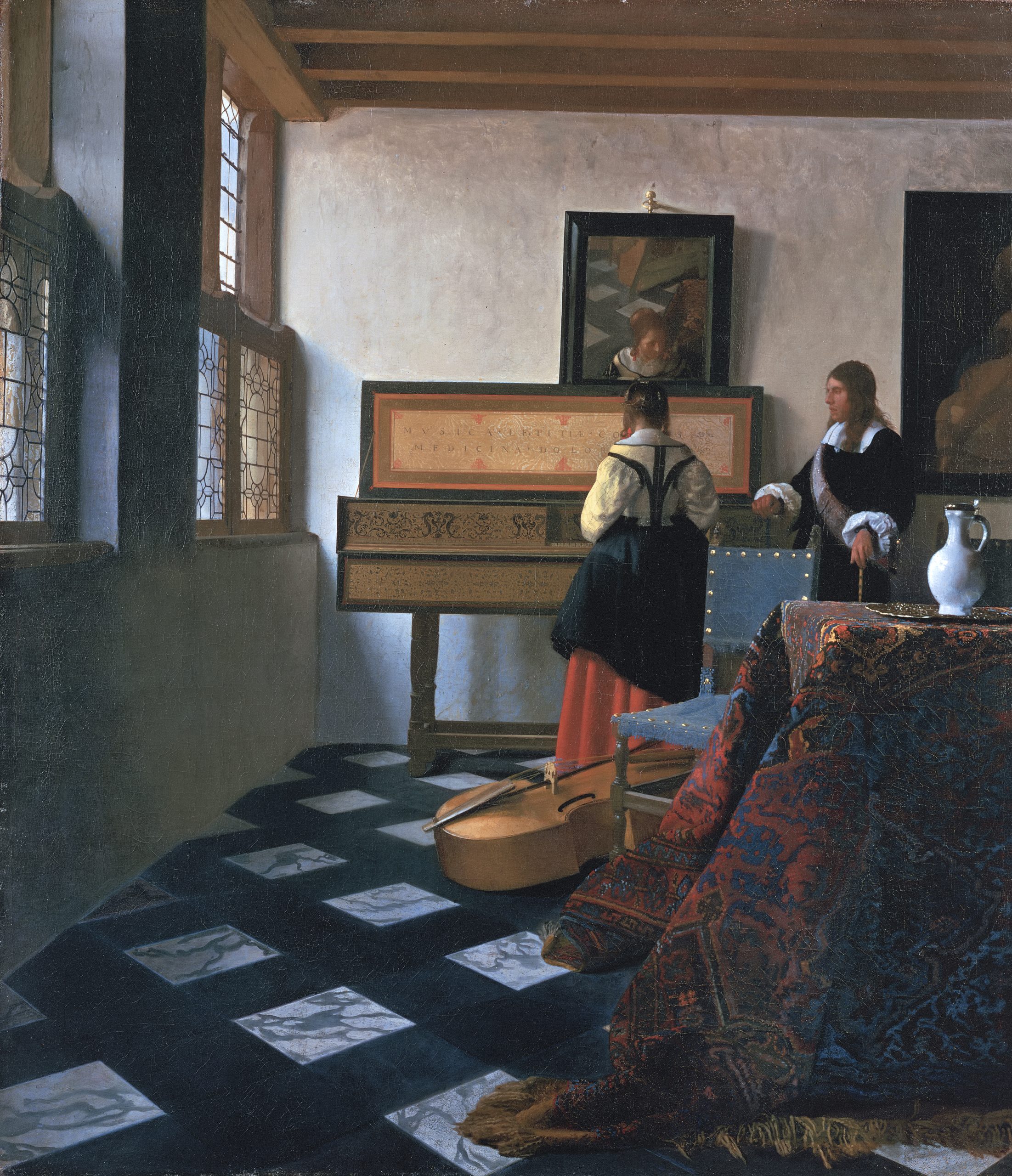
Gerald Weinberg’s paradoxes of software systems, a Vermeer with a bare wall behind it, and Tomas Tranströmer revising his way toward an ending. What joins them is the work intentionally withdrawn or left undone, and the space that decision opens.
“To be a good generalist, one should not have faith in anything. Faith is the belief in something for which there is no evidence. Every article of faith is a restriction on the free movement of thought, and thus on the free movement of the generalist among disciplines… But nobody can exist without faith in something.”
He also promotes childlike naïveté, fumbling in the dark, and being willing to look foolish because you’re looking for a greater unity or connections between things that are ordinarily understood reductively as unrelated. To be naïve is to have a natural, innocent, or artless disposition. The word stems from the Old French naïf (natural, native), which traces back to the Latin nātīvus, meaning “native, natural, or inborn.”
The idea that adults should seek a “second naïveté” comes from philosopher Paul Ricoeur to describe a “post-critical” faith or mindset that might satisfy Weinberg’s paradox of having and not having faith. It is the mature state of belief that arises after undergoing critical analysis, skepticism, or intellectual doubt. Instead of returning to naïve, literal belief, one moves forward to a symbolic, deeper engagement with truth that embraces uncertainty.
Weinberg and Ricoeur’s words circle around the concept of Shoshin (初心), or “Beginner’s Mind,” in Zen Buddhism.
Sho, 初, “beginning” or “first,” comes from a Han compound image of the beginning stage of clothesmaking: a knife and cloth.
Shin, 心, “heart” or “mind,” comes from Xin, which some people think looks like an anatomical heart, but its precursors are very clearly a different set of organs.
The apparent contradiction of the act of beginning something for the first time — yet once again — is a mental palate (or palette) cleanser, like any good puzzle or riddle. Why do these opposites belong together?
The question is a gateway into the open, childlike, beginner’s state of mind.
Ensō — one stroke, left open where it began.
Get Things Done By Not Doing Them
Paradoxes are the best riddles for opening the mind. Here’s a good one I’ve been ruminating over for a while: Wu wei (無為). It means not-doing and action without effort.
Wei 為 is a hand guiding an elephant — a task so massive, it can’t be the work of the hand at all, yet the guiding hand is necessary.
Wu wei is a Taoist concept identified with flowing water and yīn (阴), the soft powers in nature that oppose and complement yáng (阳). Yīn is retractive, passive, contractive, and receptive. Yáng is repelling, active, expansive, and repulsive. The characters for both yīn and yáng are compounds — a mound or a hill with a cloud for yīn and the sun for yáng.
Lately, I’ve been thinking about how wu wei applies in the context of the best code/poetry is the stuff you delete or decline to write. (Or, “the fastest code never runs because it was never written.”)
Karim Marucchi and Pat Ramsey got me going down this track with a blog post that referenced Rob Pike‘s “Five Rules of Programming.” These rules are memorable and have the status of a sage’s wisdom or a religious text, no doubt because of the way they are written. Pike lays out five handy axioms that are interrelated and contain some apparent contradictions that you can never fully unpack.
One is like Rich Sutton’s insight — “the bitter lesson” — in AI: Brute force is often best. “Fancy,” complex solutions may prove inefficient and ineffective. Brute force is simple and can be, in its own way, the most elegant solution.
Both Pike and Sutton reject cleverness. Pike says, Do less. The extreme version of this is Jeff Atwood’s advice, Don’t do… anything. (“The Best Code is No Code at All.”) Sutton says, Do more of the simple thing. Lots more! Wu wei is yīn-simple, proceeding by subtraction and negation. Brute force is yáng-simple, asserting and expanding.
Same root, opposite energies. Anti-cleverness (anti-overthinking?) is the shared idea.
This also resonates with things in Stewart Brand’s study of maintenance, which I’m still reading. In the first chapter, there’s a lesson from Bernard Moitessier: only simple things can be repaired with what you have on board when you’re out at sea alone. Anything complex will likely stay broken and might get you killed.
Get Even More Things Done By Extending What You Won’t Do
Wu wei can be related to a Confucian concept, Tui (推). This Han character is a compound with hands on the left pushing something away on the right, possibly a bird. Tui means actively pushing, intentionally striving, but also (in Mencius) extending what is not to be done to achieve habitual, effortless virtue.
Mencius had a method in practical morality that’s like scaling up the positive and negative forms of the golden rule from a basic empathy or revulsion. You expand on something you love or hate to apply the underlying principle more broadly:
Do more things that extend what you love — things that spark empathy and attraction.
Do fewer things — or stop doing more things — that are bigger versions of something that deeply turns you off, pushes you away, or is unattractive.
It’s less obvious and harder than it sounds. Leaning into a principle or motive this way will quickly lead from what is easy to love to things that are difficult to embrace. The impulse to withdraw that is easy to follow will lead you to decisions about things that are hard to give up.
For example, going from a love of animals, good food, and disgust for industrial cattle farming and meat processing leads many people to stop eating meat. Or, in my family’s case, when we were able, we preferred better and less meat — small farm-raised beef, pork, lamb, and chicken. This can be costly, and I rarely do it anymore, partly for that reason, but also for lack of access.
A wonderful weekend market within walking distance of my home closed last year. This visible loss in the community has been felt in many subtle but significant ways, down to how much I cook and what I eat. Most of all, I’ve had less time, fewer people around, and fewer occasions for the slow making and sharing of meals. It would be a good and balanced thing to once again expand the table with more people present and less dubiously sourced meat on it.
Another example could be the difficult decision to take or not take work or clients you don’t love, to put it mildly. How much capacity do you have for relationships where goals and values are not aligned? (Is that a simple question or a hard one?)
A “brute force” approach might be the best. Don’t get fancy; just do more of this, less of that, and get clarity on how your choices relate to your fundamental values. Let some things go. Try to balance your costs and returns on the material and more-than-material sides of the ledger.
We all do this naturally, but not always thoughtfully or with the clarity of the wise people who have reflected deeply on fundamental problems and dared to frame them in the ways that a reductive, single-disciplinary approach denies. Weinberg says most problems in system design are not purely technical but are actually unavoidable “people problems” we try to avoid:
“What of the depletion of our natural resources by an ever-increasing population in an ever-more-wasteful economy? What of expanding technology, usually the obedient servant but occasionally the terrible master? What of grisly wars and impoverished peace? What of death, and what of me, dying?”
What if we started facing them, out of necessity, just to survive and sustain societies worth living in?
Must Do and Won’t Fix Both Circle an Empty Canvas
The Taoist idea of action without effort (very yīn), and the Confucian idea of conscious effort (very yáng) both aim for a form of “effortless virtue.”
The Daoist approach is yielding — relaxing restrictions, letting go of desires, and going with the natural flow of life. By negation and diminishment, space is opened in the way that less can be additive and, paradoxically, more.
The Confucian approach is active cultivation — education, ritual, and discipline. By habit-forming practice, effort falls away into simply what one does, so this positive path also leads to more being achieved with less or even no cognitive effort.
Normally associated with the path of passivity and negation, the first approach can lead to an additive result. Normally associated with the path of active, positive assertion, the second approach can lead to a subtractive result. Both approaches orbit a central nothing — no-mind and no-being — like śūnyatā, which a Taoist might see in the empty centre of the Dharma wheel in Buddhism.
The subtractive path arrives at more; the additive path arrives at less. Both orbit nothingness — kong 空.
For the Mahayana Buddhist, śūnyatā is kōng, 空. It signifies liberation in “the skillful means that disentangle oneself from defilement and unsatisfactoriness.” (Sunyata in the Mahayana Context) The pictographic origins of kōng are in the image of absence — empty air in a “cave,” “hole,” or “cavity.” It’s the silences and open spaces of non-being between things — words, images, actions, and people — that give shape and hold space for their being.
The Confucian comes at the goal of liberation from stress and shitty work in an active, pragmatic way, fully engaged in the world. Think of it as shipping clean code (or simply “good work”) on time, at least as well as one is able, given the constraints that frame what can be done, what must be done, and (the part most often overlooked) what is most important not to do, to leave undone and untouched.
The root of śūnyatā (“empty” or “void”) is śūnya (“nothing”), which lies behind the origin of zeroas a mathematical concept in India. Variations of the Sanskrit origin all signify the number “zero” in Hindi, Marathi, and Nepali. Zero came into Western mathematics from India through the Arabic sifr (“empty,” “nought,” “cipher”).
The apparent contradiction in an emptiness that swells and increases is a simple riddle: a tumulus or burial mound (a tomb), and also a womb. The older words behind our words are rich symbols of the duality of birth and death, united by self-negation, withdrawal, and contraction that opens space for new life.
The Western mind, with its horror vacui, has never liked the idea of zero or an expanding void since Aristotle argued in hisPhysics that true emptiness cannot exist in nature. Negation is thought of as negative in value, associated primarily with evil. But nature really doesn’t abhor a vacuum.
Johannes Vermeer, Woman Reading a Letter, c. 1662–63. Rijksmuseum.
In “The Music Lesson,” which the Royal Collection catalogues by its plainer name, Lady at the Virginals with a Gentleman, nearly half the picture is taken up by the floor. (A virginal is a type of harpsichord.) Vermeer gives over the whole foreground to floor tiles, a table, and the light crossing them. He places the two young people far back against the wall, so that most of what you are looking at is the room rather than the people in it.
Detail of Johannes Vermeer, Lady at the Virginals with a Gentleman (The Music Lesson), c. 1662–65. Royal Collection Trust.
If you haven’t read Tranströmer’s “Vermeer” before, you should read it now to avoid a spoiler. It touches everything I’ve written about so far, but I’m going to skip to Bly+Tranströmer’s ending.
The airy sky has taken its place leaning against the wall.
It is like a prayer to what is empty.
And what is empty turns its face to us
and whispers:
“I am not empty, I am open.”
Bly and Tranströmer had a very long and special friendship. When Tranströmer got the Nobel Prize, “Vermeer” was one of the poems he read, as he often did, in both Bly’s English and his own Swedish.
Den klara himlen har ställt sig på lut mot väggen.
Det är som en bön till det tomma.
Och det tomma vänder sitt ansikte till oss
och viskar
“Jag är inte tom, jag är öppen”.
When I first read these lines, they reminded me of the Hebrew word and mystical concept of Tzimtzum (“withdrawal,” “contraction”) in Lurianic Kabbalah. It’s the boundless, undifferentiated divine essence withdrawing its infinite light to create a void that is also a finite, constrained space. These are commonly interpreted as feminine and maternal divine energies creating a womb for existence. From it, worlds and beings emerge from non-being — especially beings with their own freedom to create within the given boundaries.
Today I learned that this mystical element at the end of “Vermeer” has more to do with śūnyatā as an intentional ingredient. Estonian poet Jaan Kaplinski — another long-corresponding friend of Tranströmer and translator of Taoist and Buddhist texts — convinced Tranströmer to change his original ending from “emptiness” (tomhet) to “openness” (öppenhet), with śūnyatā specifically in mind. Eventually, this was simplified to “open.” What a difference it makes!
Kaplinski wrote about this in a remembrance to his friend:
“There is one of Tomas’s poems in the wording of which I too have a small role. Namely, the poem about Vermeer, where it is said that emptiness is not empty, but open. This idea came to Tomas from my letter, in which I tried to explain how I understand the Buddhist-Taoist concept of emptiness (Sanskrit śūnya, Chinese kōng). In my view, what is usually translated and interpreted as emptiness can perhaps also be interpreted as openness, as boundless-being.” (Kaplinski 2015; translated by Claude)
University of British Columbia Professor Thomas Salumets tells this story in “Masterful Servants: Jaan Kaplinski and His Soulmate Thomas Tranströmer,” Methis: Studia Humaniora Estonica 29 (2022): 15-28. The main text is Estonian, but it’s followed by an English summary on pp. 29-33, where Salumets says Kaplinski and Tranströmer bonded deeply over “a reversal in our understanding of the ego.”
Collectively, both poets agreed, we, as human beings, would be well advised to embrace a less intrusive role in the world to which we belong. Importantly, what Kaplinski and Tranströmer advocated does not amount to an impoverishing stance. On the contrary: only when we step away from our previous deeply entrenched positions of human dominance, both poets agreed, a richer world and more sustainable sense of self can come into view. To at least gain a glimpse of the fuller complexity of what brought both poets together, the observations offered in this article are meant to help us understand how, for Kaplinski and Tranströmer, changes in our view of the ego embody “openness”. Instead of increased ego noise, they urged the merit of a more modest ego. Not preoccupied with themselves, their goals and desire to intervene, both poets wrote poems focussed on the diminished ego as a key value. The more we step into the background – Kaplinski and, together with him, Tranströmer believed – the more the world opens up and the more we ultimately flourish.
That’s very Wu Wei: “The more we step into the background, the more the world opens up, and the more we ultimately flourish.”
In addition to seeing “openness” surface in their self-effacing view of themselves, and, associated with it, their concentration on a vision of a world beyond human design, this article furthermore draws attention to another equally prominent manifestation of “openness” that brought both poets together: how can language make “openness” appear, they asked? We are invited to consider several intertwined answers Tranströmer and Kaplinski offered. They include embracing the untamed and stepping away from any decorative use of language – “all rhetoric must be left behind,” Tranströmer, echoing Kaplinski, categorically insisted; evoking the self-cancelling of language itself; or moving altogether beyond language: seeking to transcend it by employing a theme, introducing a practice, or setting up a signpost, all meant to point away from language.
Tom (“empty”) comes from Old Norse tómr (“empty” or “vacant”). Their possible PIE ancestors (tewh₂- and tum-) have to do with mounds and things that swell. (Where have we heard that before?) The Latin tumulus, Greek tŭ́mbos, and English tomb all mean the same thing and may derive from those roots, too. Although they have a different lineage through ḱówH– (“cave” or “hollow”), could it be more than coincidence that śūnyata (“empty”), śūnya (“nothing”), and śvi (“to swell”) carry along the same twinned ideas of emptiness and increase, perhaps even tomb and womb?
In Tantric Buddhist texts, particularly in the Hevajra Tantra and related Mahayana literature, śūnyatā is linked to the cremation ground — śmaśāna (श्मशान) — which represents the ultimate, luminous nature of reality in the return of being to non-being.
Consider that in relation to another Old Master’s still-shining insight:
Tao Te Ching – Verse 11

We join spokes together in a wheel,
but it is the center hole
that makes the wagon move.

We shape clay into a pot,
but it is the emptiness inside
that holds whatever we want.

We hammer wood for a house,
but it is the inner space
that makes it livable.

We work with being,
but non-being is what we use.

— Laozi (Translation by Stephen Mitchell, 1995)
Laozi wrote that about 2,500 years ago. It’s simple, foundational, and useful.
“We work with being, but non-being is what we use.”
The wheel turns on the hub, the pot holds by its hollow, the house is lived in for its inner space.
The wheel turns because of the empty hub. The pot holds water because it is hollow. The code ships because of what was deleted. The poem lands with a breathtaking finish because of what the poet stepped back from saying.
What strikes me most is that Tranströmer’s change — from “empty” to “open” — was itself an act of the principle it describes. One poet stepping back. Another stepping forward. Tranströmer’s word made space for another word from Kaplinski.
Bly’s English keeps the felt weight of the Swedish. Though empty and open don’t share tom‘s linguistic roots, the presence of śūnyatā is there in the image. Emptiness in the image of a tomb, and its manifestation in śmaśāna, the cremation ground where the human body — and with it, the ego — is returned to dust and ashes.
In Vermeer’s “The Music Lesson,” there is a mirror above the virginal, tilted down. It shows the girl’s face, which is turned away from us, and it also shows the legs of the easel Vermeer was standing at. He appears only as the artist’s furniture — the easel he worked from — not a self-portrait, not a signature, just the trace of a man who was there and declined to appear. That is Tzimtzum with a brush in its hand, and it is the same move Tranströmer made when he took out tomhet and let Kaplinski’s word stand instead.
The ending of “Vermeer” was improved by small, quiet negations.
Not this, something more open than this.
That’s the whole lesson. The mysterious cipher of zero. Not empty. Open.